[email protected] 인용하다



[email protected] 인용하다
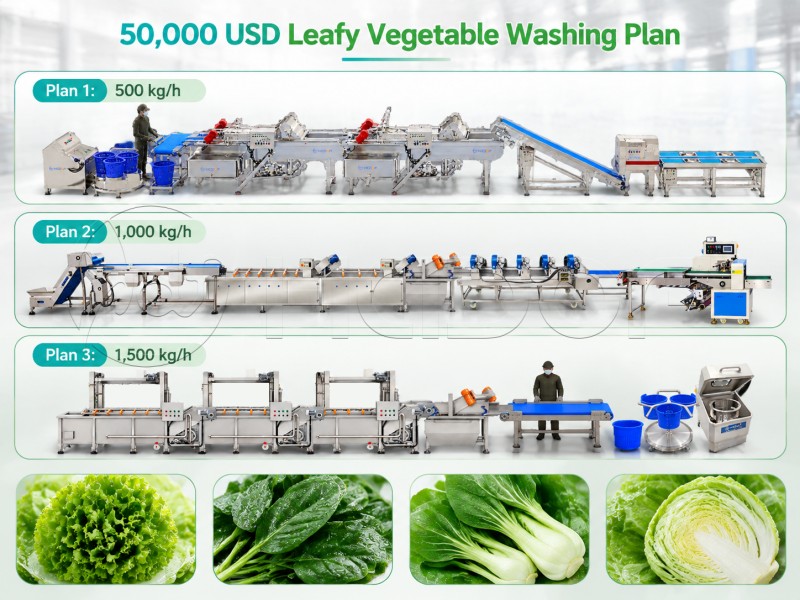
If you are planning a $50,000 investment in a leafy vegetable washing production line, you can opt for an industrial vegetable processing system including bubble washing, sanitization, conveying, and dewatering. Our engineers developed a continuous washing process of leafy greens for food processing plants, fresh-cut produce distributors, and central kitchens helping you select the ideal processing equipment based on your specific raw materials, capacity, land area, and budget. You can handle lettuce, 시금치, 양배추, 물 시금치, 그리고 겨자잎 before fresh-cut preparation, 포장, 콜드체인 유통. If your budget under $50,000, we can also develop a more economical solution by adjusting specific equipment configurations.
In fact, a leafy green cleaning plan does more than clean raw produce. For commercial vegetable processing businesses, it affects production efficiency, later food processing flow, the labor arrangement, and finished product quality. 그러므로, we will evaluate your raw materials, production targets, and sales channels before recommending leafy vegetable processing machine or complete cleaning line.


첫 번째, fresh-cut vegetable processors need reliable equipment to transform farm vegetables into clean ingredients for retail, catering, and packaged sale. For instance, your factory may purchase lettuce, 양배추, and spinach before sorting, washing, 절단, and packaging them. A continuous leafy vegetable washing line helps your team establish an organized vegetable preparation process. 뿐만 아니라, you can choose vegetable cutter, dewatering machine, and weighing and packaging equipment to develop a complete fresh-cut vegetable processing line.


그 동안에, central kitchens and catering suppliers consider daily throughput, hygiene management, and labor efficiency. School canteens, hotels, restaurant chains, and institutional catering businesses often handle substantial quantities of fresh vegetables within limited time. Our bubble vegetable washers reduce repetitive soaking and manual transfers. 그 동안에, we coordinate gentle cleaning with ready-to-cook preparation schedules. 따라서, your central kitchen can handle more leafy vegetable preparation with fewer workers.


Similarly, vegetable packing plants and cold-chain distributors also use this leafy green cleaning system. They buy leafy vegetables from farm cooperatives. 첫 번째, these companies require efficient washing and surface water removal. 그 다음에, the clean leaves move to sorting, 계량, 포장, and cold storage. In addition, a leafy vegetable washing line gives these companies a steady cleaning and draining procedure. 그러므로, they can prepare large leafy vegetable batches for supermarkets and food service clients.
하지만, if customers primarily handle potatoes, carrots, beets, and other root vegetables with thick soil, we typically suggest using a brush roller washer, or a peeling equipment, rather than relying solely on a leafy vegetable bubble cleaning system.
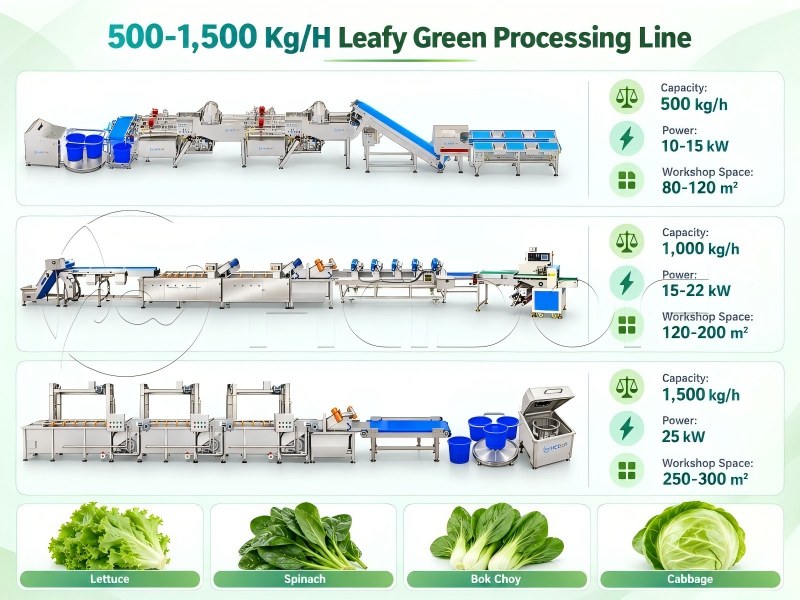
If your equipment investment budget is $50,000, we can design 3 leaf vegetable cleaning and deep-processing solutions—500 kg/h, 1,000 kg/h, 또는 1,500 kg/h—based on actual production scale. If you aim to produce fresh-cut vegetables ready for direct entry into retail channels, you can invest a small-scale leafy veg production project. 그 다음에, you can arrange additional funds on vegetable sorting, 절단, and packaging equipment to establish a more comprehensive ready-to-serve vegetable processing system. Conversely, if your want to supply clean leaf vegetables to large food processors, a multi-stage cleaning solution is better to meet the higher processing demands. 그러므로, we recommend the three configurations below.
If you process about 3-4 tons of leafy vegetables daily and plan to supply clean products to local restaurants, small supermarkets, or central kitchens, 우리는 500 kg/h small leafy vegetable cleaning and processing solution. Our proposal combines a sorting table, vegetable cutting machine, vortex washer, vibrating drainer, centrifugal dehydrator, 그리고 semi-automatic packaging machine. 게다가, this configuration allows you put more investment into fresh-cut vegetable production rather than purchasing an oversized washing system. For instance, you can cut spinach into fixed lengths or package washed and dehydrated lettuce for retail distribution. 이런 식으로, you buy a complete fresh-cut vegetable processing line for small-scale food factories, not just a washing system. 추가적으로, we can adjust the automation level of sorting tables, vegetable cutting machines, packaging machines, and conveying systems according to your budget.
자세히 알아보기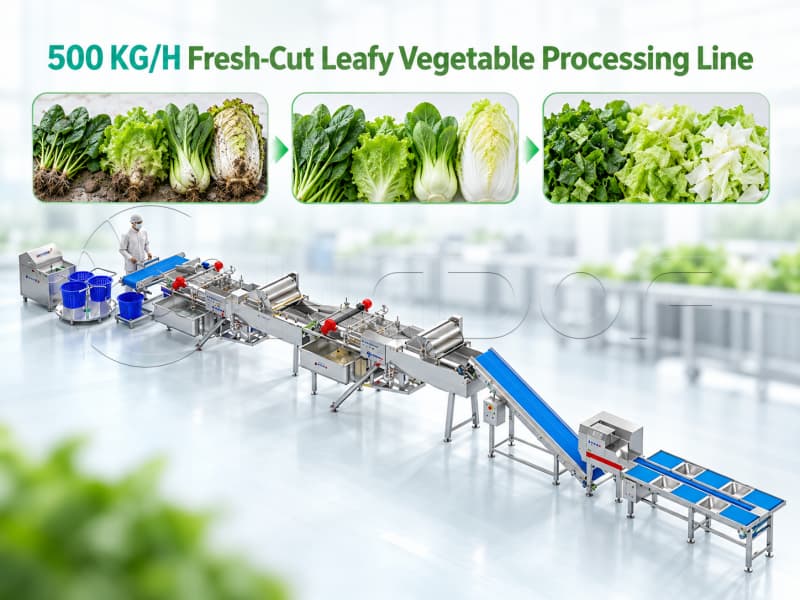
For fresh vegetable distributors, food processing plants, and catering suppliers handling 6–8 tons of leafy vegetables daily, we recommend a medium leafy vegetable cleaning production line with a capacity of 1,000 kg/h. This plan includes a feeding elevator, 에이 first bubble washing machine, and a second clean-water rinsing machine. 게다가, it combines a vibrating drainer, air drying conveyor 그리고 pillow packaging equipment. 뿐만 아니라, if the customer produces fresh cut leaf vegetables or ready-to-cook vegetables, our team can supply a leafy green cutting equipment or change the order of cutting and fine washing. Compared with the 500 kg/h plan, this configuration focuses on continuous feeding, washing efficiency, and equipment connection. 그 동안에, customers still have the opportunity to save investment for future cutting, 정렬, or packaging equipment, thereby expanding their vegetable distribution business.
자세히 알아보기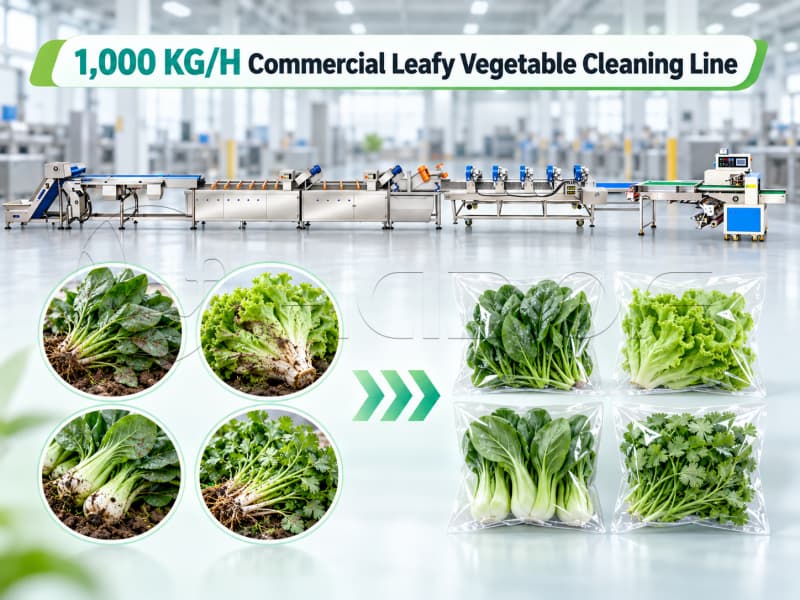
For large vegetable processing plants, central kitchen suppliers, and cold-chain distribution companies, 우리는 1,500 kg/h industrial leafy vegetable cleaning system. 첫 번째, our team can design a three-stage bubble washing system with a 진동 탈수 기계, and an optional centrifugal dehydrator. In addition, it includes an automatic dosing device, ozone treatment equipment, and a water circulation system. 다음, the three washing stages can remove soil, cleaning & 위생, 그리고 마지막 헹굼. Each bubble washing machine has the capacity of 2,000 kg/h. Compared to the previous two solutions, it ensures multi-stage cleaning, continuous conveying, and water treatment, making it particularly suitable for food processing plants that already possess cutting, 정렬, or packaging equipment. 게다가, you can add cutting, 계량, and packaging machines at the end of this line later.
자세히 알아보기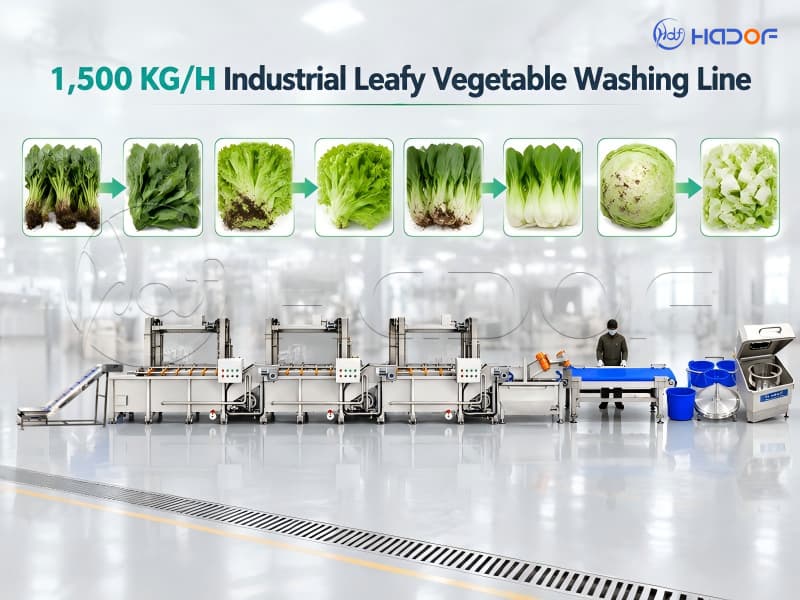
Different leafy vegetable washing lines need different plant areas and power supplies. Our engineers arrange the cleaning, 절단, 탈수, 포장, and walking space for your plant layout design. 게다가, we also account for your later processing needs. For a 50,000 USD budget, we suggest the three production scales below.
For commercial vegetable processing projects, equipment purchase costs represent only part of your investment decision. You also need to consider long-term labor, water, electricity, cleaning chemicals, and equipment maintenance expenses.
첫 번째, an automatic vegetable washing system can reduce repetitive manual soaking, transferring, and handling operations. 예를 들어, a factory may originally employ eight workers for manual vegetable cleaning and transportation. After installing a continuous vegetable washing line, the factory could reduce these positions to three operators. If each worker costs $260–340 monthly, you could potentially save approximately $1,300–1,700 per month in labor expenses.
게다가, continuous leafy vegetable washers use water-level control, recirculation, and wastewater discharge management to reduce unnecessary water consumption.
추가적으로, you can adjust conveyor speed and washing intensity through variable-frequency control. 그러므로, your equipment can handle different leafy vegetables while supporting more flexible production schedules.
If your total project budget cannot exceed $50,000, you should first understand the scope of the equipment quotation. 그만큼 EXW price of a vegetable washing line mainly covers the machinery listed in the quotation.
하지만, international buyers may also need to cover equipment packaging, inland transportation within China, ocean freight, and cargo insurance. 게다가, destination port customs clearance, import duties, local taxes, and inland delivery may increase the total investment.
예를 들어, you may plan to import vegetable processing equipment from China to Vietnam, Thailand, Malaysia, or other Southeast Asian countries. In this case, we can develop a shipping proposal based on your factory location, destination port, and final packaging dimensions.
추가적으로, you should budget for workshop modifications, water supply, drainage construction, electrical connections, local installation labor, and production testing materials.
그러므로, approximately $50,000 can serve as your core vegetable washing equipment budget if you already have a suitable workshop. Existing drainage facilities and downstream packaging equipment can also help reduce additional investment.
하지만, a completely new fresh-cut vegetable processing plant requires a larger investment. You also need to consider factory infrastructure, auxiliary processing machinery, and other project expenses.
We consider more than the machines our customers intend to purchase. Our engineers also evaluate whether the equipment matches your raw materials, processing capacity, and final products.
Initially, we analyze your vegetable varieties, raw material conditions, hourly output, workshop layout, 투자예산. 그 다음에, our engineers determine a suitable vegetable washing procedure and equipment configuration.
예를 들어, delicate leafy vegetables require careful water-flow adjustment and gentle conveying to minimize product damage. In contrast, heavily soiled vegetables require more attention to preliminary washing time, wastewater discharge, and water recirculation.
다음, we provide detailed equipment specifications, process flow recommendations, quotation lists, and necessary factory layout drawings. 게다가, our engineers can customize machine dimensions, control cabinets, conveyor heights, and equipment connections according to your requirements.
If you prefer specific electrical or mechanical component brands, we can assist with configuration confirmation and procurement cost calculations. 뿐만 아니라, we can provide available certification documents for applicable equipment models, alongside product photographs, technical videos, and inspection reports. These documents help your purchasing team evaluate machine quality and technical suitability.
For similar customized vegetable washing line projects, our reference manufacturing lead time generally ranges from 35–45 working days. 하지만, the final delivery schedule depends on your equipment configuration and our production arrangements.
Before shipment, we can organize Factory Acceptance Testing (FAT) according to the agreed inspection scope. Our engineers inspect major moving components, conveyor connections, and electrical control functions during these tests.
During installation, we provide free remote technical guidance. 추가적으로, we can arrange on-site installation supervision, equipment commissioning, and operator training according to the contract.
We also provide a 12-month equipment warranty, while the final contract determines the specific warranty conditions.
If you plan to invest approximately US$50,000 in a leafy vegetable washing line, we can design different equipment combinations. Our engineers consider your raw materials, required capacity, 작업장 조건, 투자예산.
예를 들어, we recommend bubble washing, conveying, and dewatering solutions for lettuce, 시금치, 양배추, 겨자잎, and other leafy vegetables.
게다가, fresh-cut vegetable processors can add vegetable cutting machines, vortex vegetable washers, vegetable sorting conveyors, weighing machines, 그리고 packaging equipment. These machines help you expand your vegetable preparation process into cutting, 정렬, 계량, 및 포장 작업.
In addition, Hadof supplies root vegetable washing and peeling lines, vegetable blanching equipment, IQF vegetable freezing lines, and fruit and vegetable drying machinery. 그러므로, you can gradually expand your food processing business according to your production plans.
You can share your vegetable varieties, 목표 용량, factory dimensions, and equipment budget with Hadof. Our engineers will recommend a suitable leafy vegetable washing line design and prepare detailed specifications, processing plans, and customized quotations.
메시지를 남겨주세요
 무료 견적
무료 견적
 한국어
 English
 Afrikaans
 Shqip
 العربية
 Հայերեն
 Azərbaycan dili
 Беларуская
 Bosanski jezik
 Български
 မြန်မာစာ
 Hrvatski
 Čeština
 Dansk
 Nederlands
 Eesti keel
 Wikang Filipino
 Suomi
 Français
 Galego
 Deutsch
 Ελληνικά
 हिन्दी; हिंदी
 Magyar
 Íslenska
 Bahasa Indonesia
 Gaeilge
 Italiano
 日本語
 Қазақ тілі 한국어
 ພາສາລາວ
 Latīna
 Latviešu valoda
 Bahasa Melayu
 Монгол
 नेपाली
 Norsk
 Português
 Português do Brasil
 Română
 Русский
 Cрпски језик
 Slovenčina
 Slovenščina
 Español
 Svenska
 ภาษาไทย
 Türkçe
 Українська
 Oʻzbek tili
 Tiếng Việt
이 페이지의 콘텐츠를 복사할 수 없습니다.