[email protected] Tilvitnun



[email protected] Tilvitnun
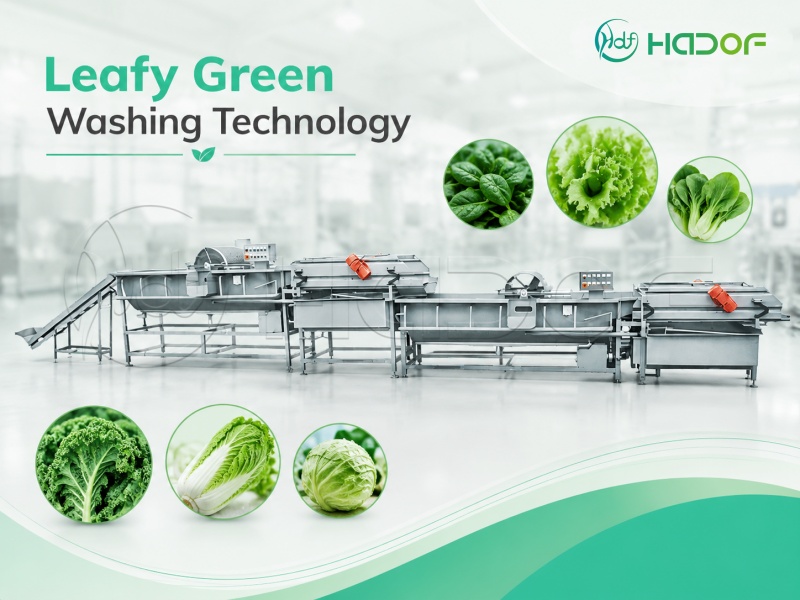
Leafy green vegetables have thin leaves, large surface areas, and complex folds. Þess vegna, spinach, lettuce, cabbage, and bok choy often carry sand and floating impurities. Ordinary high-pressure washing may damage leaves. Á meðan, insufficient washing may affect food safety, packaging quality, and shelf life.
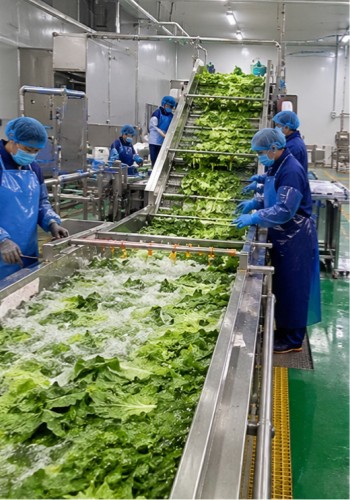
Today, modern leafy green washing technology combines vortex washing, overflow impurity removal, skolun, vibrating dewatering, or air drying. Þar af leiðandi, food processors can achieve stable production, better product appearance, and improved processing efficiency. From our perspective as a food machinery manufacturer, washing performance depends on water flow control, impurity separation, leaf protection, drainage efficiency, and leafy vegetable production line design.
Different leafy vegetables require different washing procedures and treatment methods. Þess vegna, equipment selection should match product size, leaf structure, and production targets.
 Fáðu tilboð
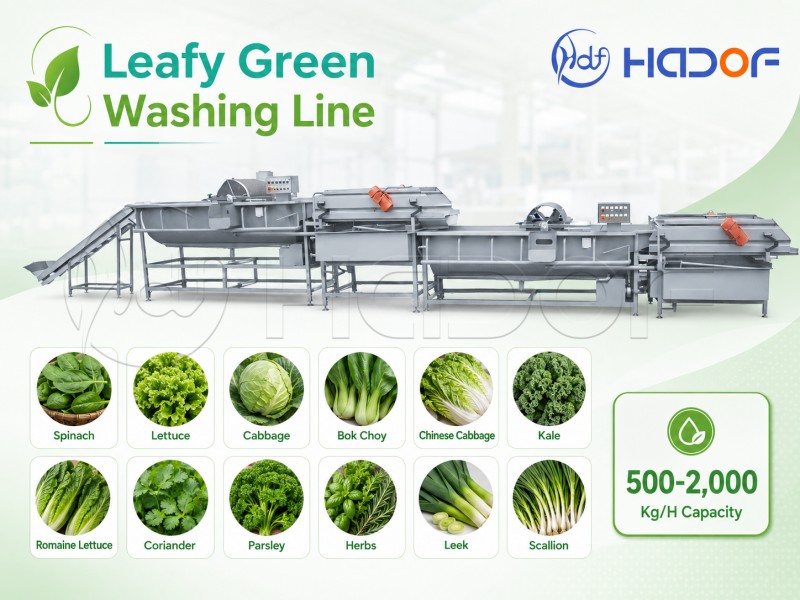
Our leafy green washing system can handle spinach, lettuce, cabbage, bok choy, Chinese cabbage, kale, romaine lettuce, coriander, parsley, jurtum, leek, scallion, and leafy stem vegetables. Þar að auki, customers can use the same vegetable washing system for whole leaf washing, cut vegetable washing, salad vegetable washing, and pre-cut leafy greens before freezing or packaging.
Ennfremur, our standard vortex leafy green washing line commonly operates around 500 kg/klst. Auk þess, our engineering team can provide customized leaf vegetable production line design according to factory space, product type, and investment budget. Our company can customize the continuous vegetable cleaning system like 1000 kg/klst, 1500 kg/klst, or 2000 kg/klst when clients need a cost-effective quotation or a complete processing line for sale.
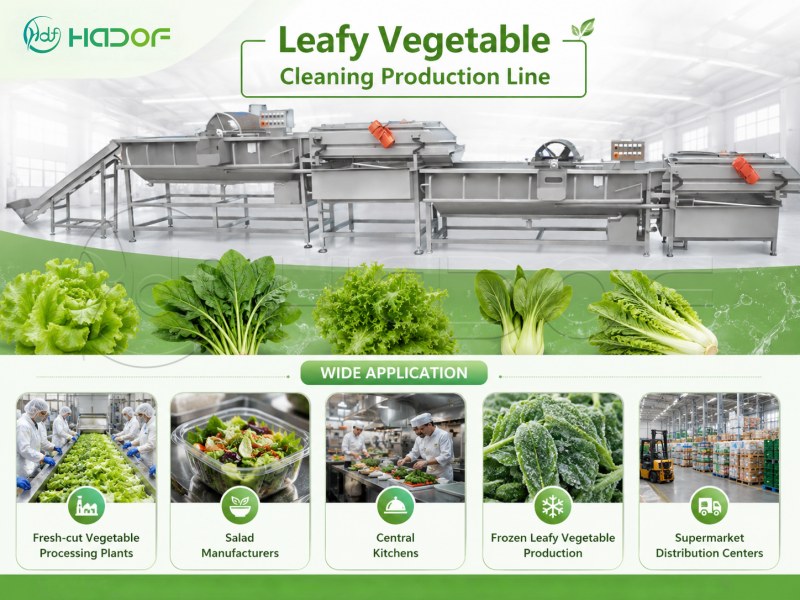
Fresh-cut vegetable processing plants use leafy green vortex washing technology to help reduce sand, protect leaves, and prepare vegetables for ready-to-cook products.
Salad manufacturers process lettuce, spinach, romaine lettuce, and mixed greens daily. Þess vegna, gentle washing technology and centrifugal drying equipment help maintain product quality and appearance.
Central kitchens require continuous production and stable output. Consequently, automated washing machinery reduces labor dependence and improves production management.
Frozen leafy vegetable production often connects washing, klippa, blanching, kælingu, hraðfrysting, and packaging. Þess vegna, the frozen spinach and frozen cabbage washing process should remove soil before blanching and quick freezing.
Frozen leafy vegetable production often connects washing, klippa, blanching, kælingu, hraðfrysting, and packaging. Þess vegna, the frozen spinach and frozen cabbage washing process should remove soil before blanching and quick freezing.
 Fáðu tilboð
Fresh-cut vegetable factories, salad processing plants, central kitchens, supermarket vegetable distribution centers, frozen vegetable processors, catering supply chain companies, agricultural cooperatives, and canteen suppliers often need industrial leafy green washing equipment. Hins vegar, their common problems remain similar. Manual washing requires intensive labor and often delivers inconsistent cleaning results. Á meðan, delicate leafy vegetables can suffer damage during aggressive washing procedures. Sand, insects, and floating impurities also remain difficult to remove from leaf folds. In addition, excess surface moisture often reduces packaging quality and storage performance. Þess vegna, customers need a continuous washing process with adjustable water flow, impurity management, stable dewatering, and affordable production cost.
 Fresh-cut vegetable processing plants
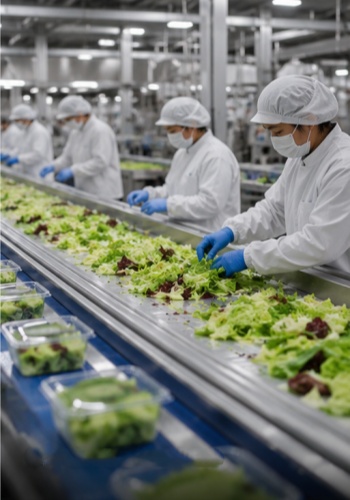 Salad manufacturers
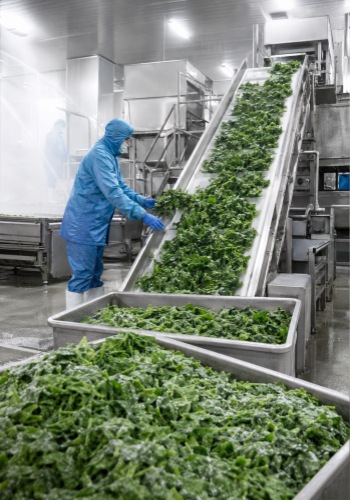 Frozen leafy vegetable production
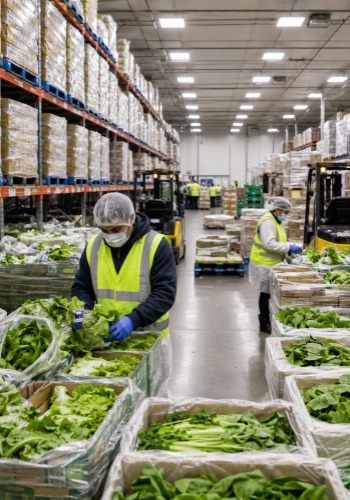 Supermarket distribution centers
Different leafy products require different washing systems. Here are two leafy washers for your choice.
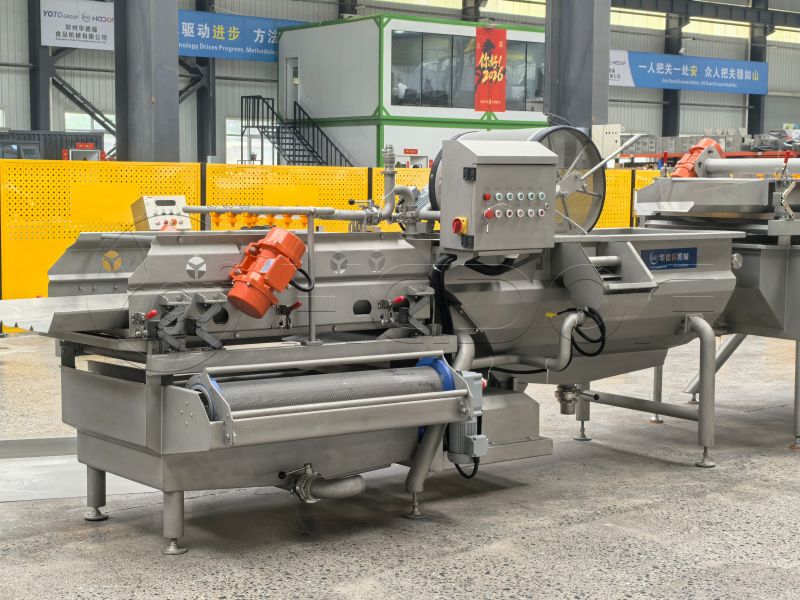
➤Vortex washing remains the most popular leafy green washing technology. A turbine or water pump drives the water to create a powerful circulating water vortex within the tank, causing leafy vegetables to tumble and rotate 360 degrees while suspended in the flow. Sand settles naturally at the bottom and is discharged via a drain valve.
➤Þar að auki, the process avoids direct conveyor belt friction. Þar af leiðandi, customers achieve high cleaning efficiency with lower leaf damageand prevent clogging. Einnig, this system has vibrating discharge screen to assist with leaf dewatering.
➤Typical Applications include: Pre-cut leafy vegetables such as lettuce, spinach, bok choy, and endive; suitable for salad and ready-to-use vegetable processing lines.
learn more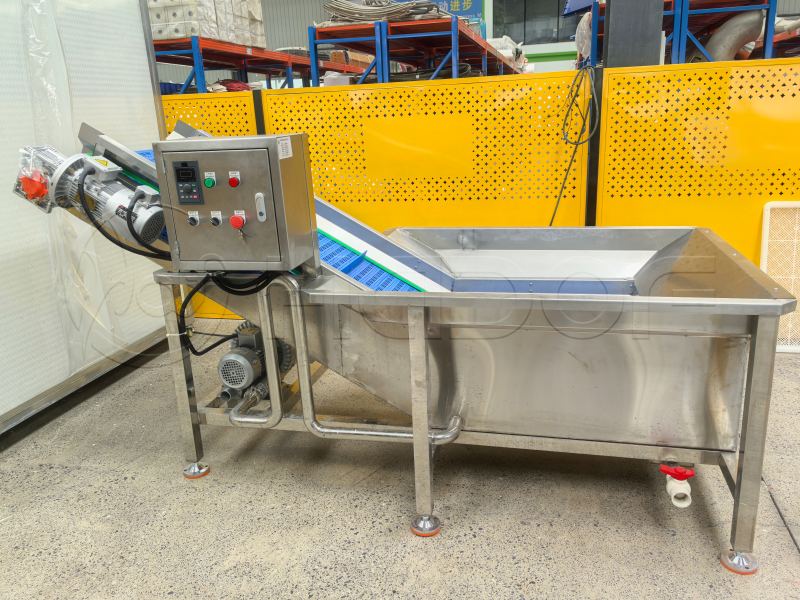
➤Generally, customers should consider bubble washing when leaf dimensions exceed 15 cm.Til dæmis, when individual leaves is large or uncut pieces are long, such items are prone to breakage in vortex washers due to their size, making bubble washing the necessary alternative.
➤Large leafy vegetables require a gentler treatment method. Bubble washing technology generates continuous air bubbles and soft water circulation. Þess vegna, the leaf vegetable washing process simulates gentle manual washing without excessive mechanical stress.
➤Typical applications include: Large or long-stem leafy vegetables such as whole cabbage, whole lettuce, large bok choy, and celery; commonly use bubble washer as a pre-treatment step prior to blanching or dehydration.
learn moreGenerally speaking, vortex washing technology is the preferred method for leafy vegetable cleaning solutions. Because it utilizes circulating water to create a powerful vortex that keeps the green vegetables suspended and tumbling during the rinse. Þannig, it particularly suitable for chopped or delicate premium leafy greens. Conversely, for larger leaves (approximately 15-30 cm in size or whole, uncut heads), we recomment bubble washing technique to prevent the crushing damage or tangling that can result from vortex action.
A complete leafy green washing process should control feeding, flokkun, þvott, impurity removal, skolun, and dewatering. Þar að auki, each step should match product size, soil level, getu, and final product form.
Overall, modern leafy green washing technology combines many features to help customers protect fragile leaves, improve cleaning consistency, reduce labor pressure, and prepare products for safer packaging applications.
The vortex water flow allows leafy greens to roll and separate naturally in water, reducing direct mechanical damage. Hence, this washing technique allows spinach, lettuce and other delicate leafy vegetables. This gentle movement reduces leaf tearing, edge bruising and product loss while still exposing folded surfaces to water for more uniform washing and cleaner overall results.
A combined soaking and vortex washing process helps loosen sand and soil attached to roots, stems and folded leaves. It’s suitable for spinach, cabbage, and bok choy with soil still attached to the roots. Heavier particles settle at the tank bottom and are discharged through drainage structures, while floating insects, hair and light debris are removed by overflow, screens and circulating filtration systems more effectively.
Leafy green washing is not a single cleaning step. According to the capacity, product type and hygiene requirement, the leafy green cleaning line may have multi grade configuration.
This multi-stage design helps remove sand, floating impurities, insects and fine residues step by step, instead of relying on one high-impact washing process.
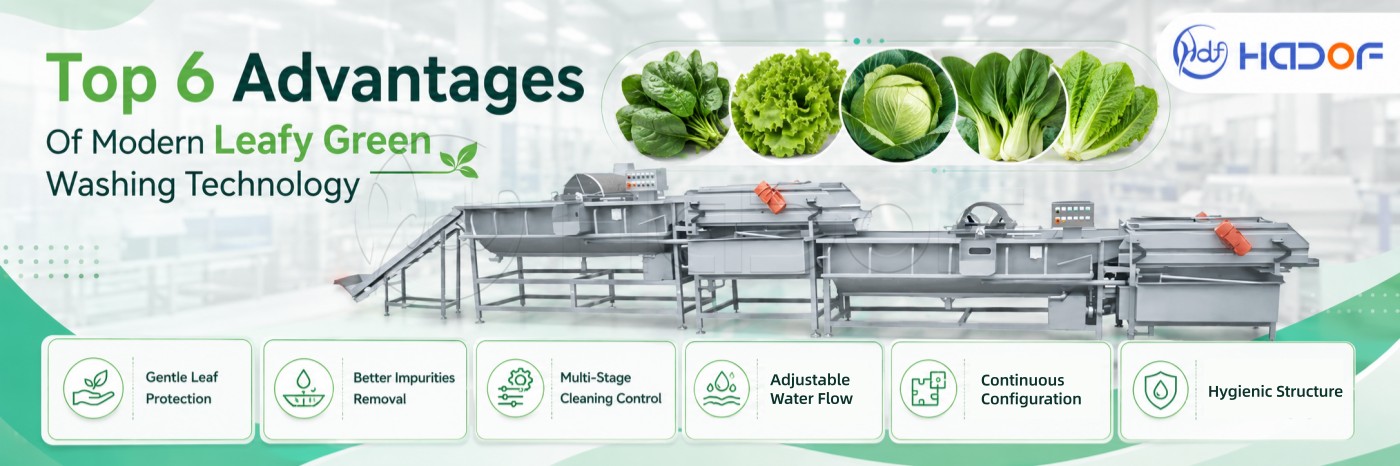
Different leafy greens require different washing strength. A professional leafy green washing line should allow operators to adjust water flow, spray volume, conveyor speed and washing time according to the raw material.
Compared with direct high-pressure washing, adjustable vortex washing can improve cleaning efficiency while better protecting tender leaves.
Leafy green washing lines can be configured according to different production scales, from small central kitchens to large fresh-cut vegetable factories. The equipment modules can be combined based on material condition, output target and final product type. This modular design allows customers to start with a practical configuration and expand the line later according to production growth.
After washing, surface water control is critical for leafy greens. A complete leafy green washing solution should combine vibrating dewatering, air drying or centrifugal dewatering.
Proper dewatering helps improve packaging appearance and prepare leafy greens for cutting, packing or freezing.
For hygiene and maintenance, the food-contact parts are usually designed with:
In addition, the whole line layout can be customized according to raw material type, whole-leaf or cut product, target capacity, workshop dimensions, water supply, drainage position, voltage and the next process such as packaging, blanching or freezing.
A complete leaf vegetable washing line requires more than a washing machine. Þess vegna, equipment matching determines overall production performance.
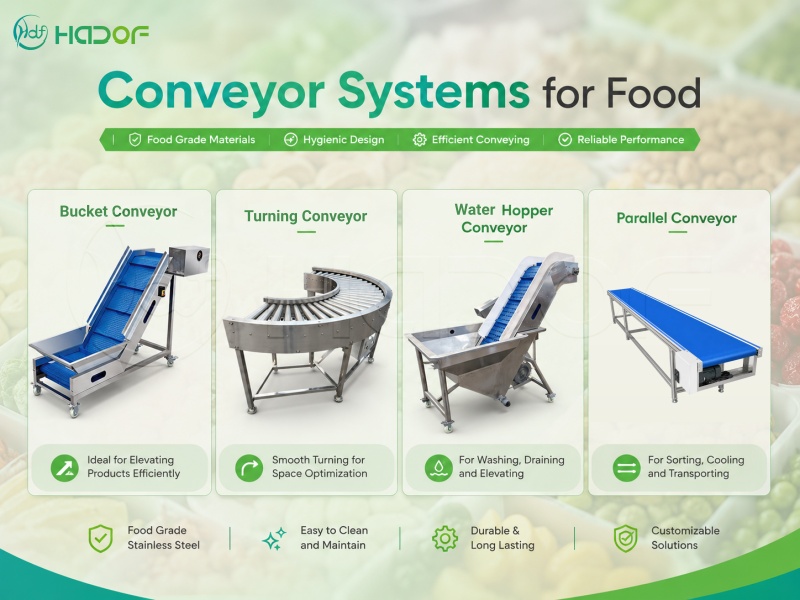
The feeding conveyor controls stable material flow and reduces manual handling. For leafy greens, stable feeding is more important than fast feeding. Uneven feeding can reduce washing efficiency and increase leaf breakage. A good leafy green washing line balances feeding, þvott, inspection, dewatering, and packaging. Þar að auki, they connect the whole leaf green production process and supports straight, L-shaped, or U-shaped vegetable factory layout design.
Fáðu tilboð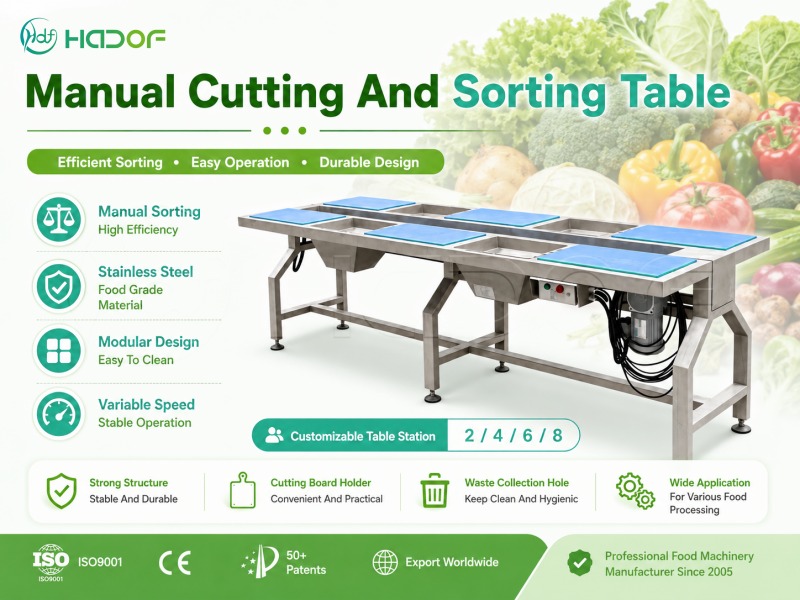
We suggest place the sorting platform for the upstream section of leafy vegetable processing lines. And it removes root residues, yellow leaves, damaged vegetables, and visible impurities. Manual inspection reduces the impurity load for the subsequent continuous washing process. This pre-sorting step is ideal for central kitchens, fresh-cut vegetable distribution centers, and processing plants. The length of the sorting section is customizable based on the number of operators and the condition of the raw material, accommodating 4 til 8 sorting stations. A 6-station sorting platform is particularly suitable for continuous leaf veggie processing lines with a capacity of 800–1,500 kg/h.
Fáðu tilboð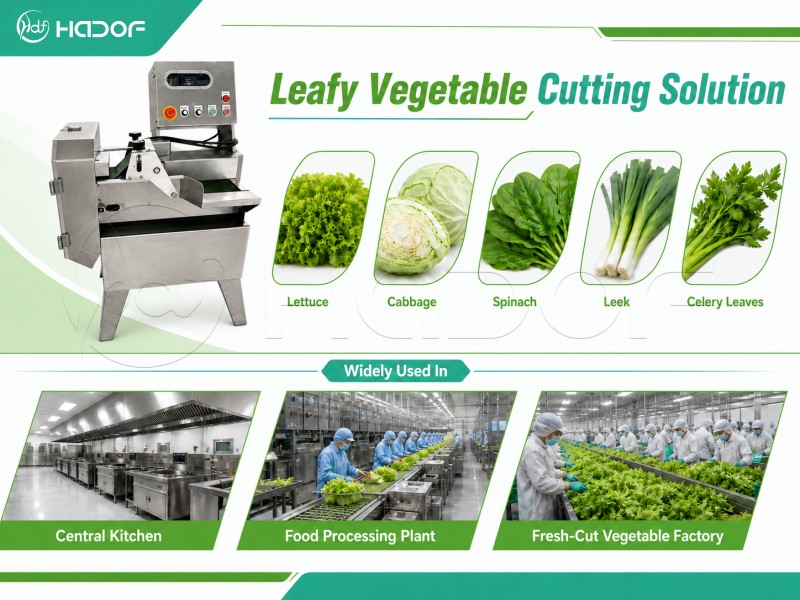
Whether to wash or cut leaf vegetables first depends on the final product positioning. For whole-leaf salads, washing prior to cutting is appropriate, whereas vegetables for group meals may be cut before washing or undergo a secondary wash. The leafy vegetable cutter processes cabbage, spinach, leek, scallion, and other vegetables into segments or fillings. So it is suitable for fresh-cut vegetable processing lines. By using variable-frequency control for the conveyor belt and blade speeds, the cutting length for leafy vegetables can be adjusted within the 1–40 mm range.
Fáðu tilboð
The vortex washing machine serves as the core cleaning equipment for leafy vegetables. Compared to standard high-pressure spraying, vortex washing is gentler on the leaves, making it ideal for delicate produce such as spinach, lettuce, and cabbage. Gentle spiral water flow replaces hard mechanical friction. Sand settles at the bottom, while floating impurities move toward overflow or filtration zones. Þar að auki, a semi-circular tank reduces dead corners and supports easy cleaning. Adjustable water flow allows for customization based on leaf thickness. A typical single unit can reach 1500 kg/klst, með 4.2 kW power and dimensions of 4,000 x 1,800 x 1,930 mm. For large scale vegetable processing or produce with high sand content (such as spinach), you’d better employ a two-stage vortex washing setup to enhance cleaning efficiency.
Fáðu tilboð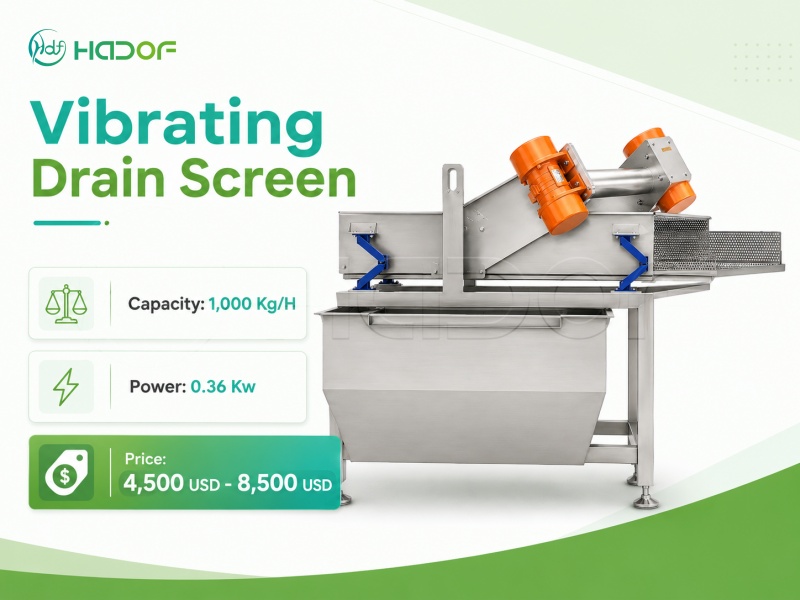
A vortex washer must combine with a dewatering unit. For leafy vegetables, this equipment primarily serves to reduce surface water. A vibrating dewatering machine, which operates at lower power, is suitable for continuous vegetable production lines. Þá, it helps reduce the load on the produce before air drying or centrifugal dewatering. Að auki, you can install nozzles at the discharge end for clean-water rinse to minimize residual impurities from the recirculating water. Final rinsing should use low-pressure nozzles with adjustable water flow rates for tender leaves. Subsequently, the leaf cleaning system can connect to an air dryer or a transfer cart leading to a centrifugal dehydrator, thereby enhancing the efficiency of the final dewatering stage.
Fáðu tilboð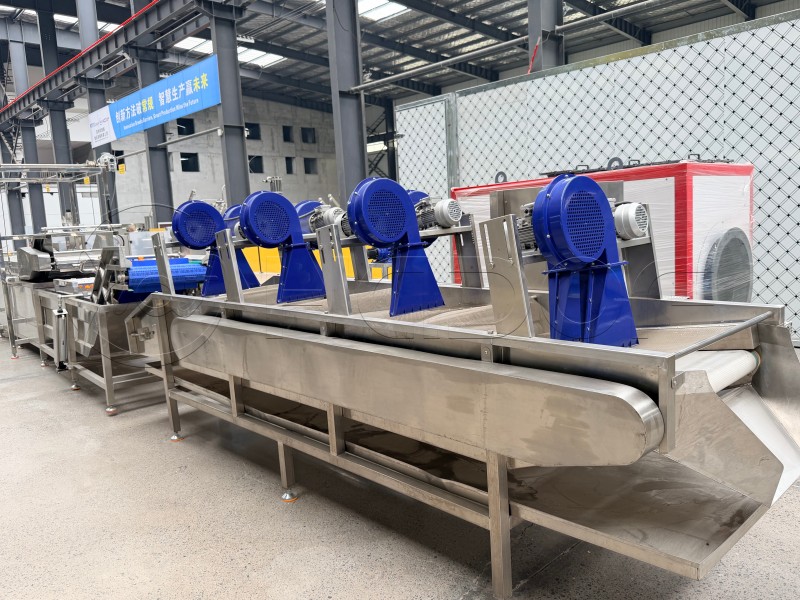
The tumble air dryer turns leafy greens from multiple angles while airflow removes surface water. Þess vegna, it suits spinach, lettuce, and other folded leafy vegetables. Unlike parallel air drying, the tumbling structure turns vegetables continuously, thereby reducing surface moisture before packaging. Þess vegna, airflow reaches more leaf surfaces and improves drying uniformity. For leafy greens, turning air drying is often more suitable than flat airflow structure when the leaves overlap, fold or retain water inside the structure.
Fáðu tilboð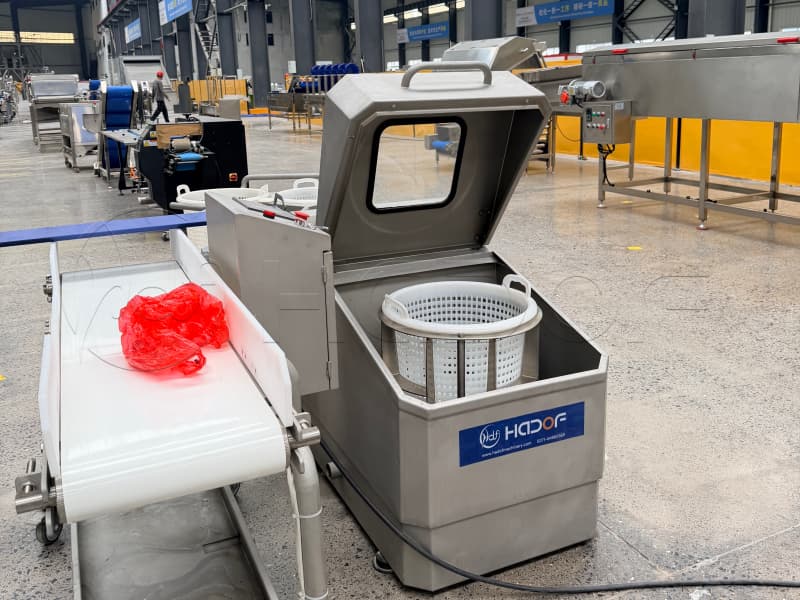
The centrifugal dewatering equipment suits salad vegetables and ready-to-eat leafy greens. It quickly reduces surface moisture and improves packing quality. Hins vegar, the operator should adjust speed and time according to leaf strength, because tender leaves need softer handling.
Fáðu tilboðVortex washing technique allows leaves to roll, open, and separate in water. Þess vegna, it reduces hard friction and improves sand removal from leaf gaps and roots. Hins vegar, customers should adjust flow strength, conveyor speed, washing time, and dewatering method according to spinach, lettuce, cabbage, or bok choy. It integrates vortex washing, vibratory draining, and rinsing. For instance, spinach and lettuce are more delicate and require lower water flow intensity, whereas cabbage are relatively more robust. When handling tender leaves, you should avoid direct high-pressure spraying and excessive mechanical agitation.
The leafy washing line removes sand through soaking, vortex tumbling, bottom sedimentation, drainage valves, and secondary washing. Þar að auki, heavy-sand vegetables need a soaking section and two-stage washing. Floating insects and hair need overflow systems, rotary filters, mesh screens, and water circulation filters.
Bubble washing technique uses air bubbles to turn the material gently. Þess vegna, it suits whole leaves and large vegetables at the first stage. Að auki, vortex cleaning process uses stronger circulating water flow. It suits cut leafy greens, folded leaves, and high-capacity continuous leafy vegetables cleaning.
Capacity depends on washing stages, rinsing design, and dewatering requirements.
✓Light-soil leafy products need 1–2 washing stages.
✓Heavy-sand vegetables need soaking, vortex washing, and rinsing.
✓Ready-to-eat salad needs multi-stage washing and centrifugal dewatering.
✓Frozen leafy vegetable lines need washing, klippa, blanching, kælingu, hraðfrysting, og pökkun.
Typical capacity references:
✓For a small central kitchen, a 300–500 kg/h leafy green washing line can usually start with a simple configuration, þar á meðal flokkun, vortex washing, og tæmandi.
✓For a standard vegetable distribution center or food processing factory, an 800–1,500 kg/klst line is more suitable, and it can include sorting, klippa, vortex washing, and vibrating draining.
✓For a large fresh-cut vegetable factory or salad processing plant, customers can choose a customized 1,500–2,000 kg/klst or higher-capacity system, usually combining sorting, klippa, multi-stage vortex washing, draining, and centrifugal dewatering.
Customers can reduce water consumption through circulating filtration tanks, staged water use, final clean-water rinsing, and regular sediment discharge. Hins vegar, the actual water cost depends on capacity, soil level, washing stages, factory standards, and local water management requirements.
Skildu eftir skilaboðin þín
 Ókeypis tilvitnun
Ókeypis tilvitnun
Ókeypis tilvitnun
 Íslenska
 English
 Afrikaans
 Shqip
Shqip العربية
 Հայերեն
 Azərbaycan dili
 Беларуская
 Bosanski jezik
 Български
 မြန်မာစာ
 Hrvatski
 Čeština
 Dansk
Dansk Nederlands
 Eesti keel
 Wikang Filipino
 Suomi
Suomi Français
 Galego
 Deutsch
 Ελληνικά
 हिन्दी; हिंदी
 Magyar Íslenska
 Bahasa Indonesia
 Gaeilge
 Italiano
 日本語
日本語 Қазақ тілі
 한국어
한국어 ພາສາລາວ
 Latīna
 Latviešu valoda
 Bahasa Melayu
 Монгол
 नेपाली
 Norsk
Norsk Português
 Português do Brasil
 Română
 Русский
 Cрпски језик
 Slovenčina
 Slovenščina
 Español
 Svenska
 ภาษาไทย
 Türkçe
 Українська
 Oʻzbek tili
 Tiếng Việt
Þú getur ekki afritað efni þessarar síðu