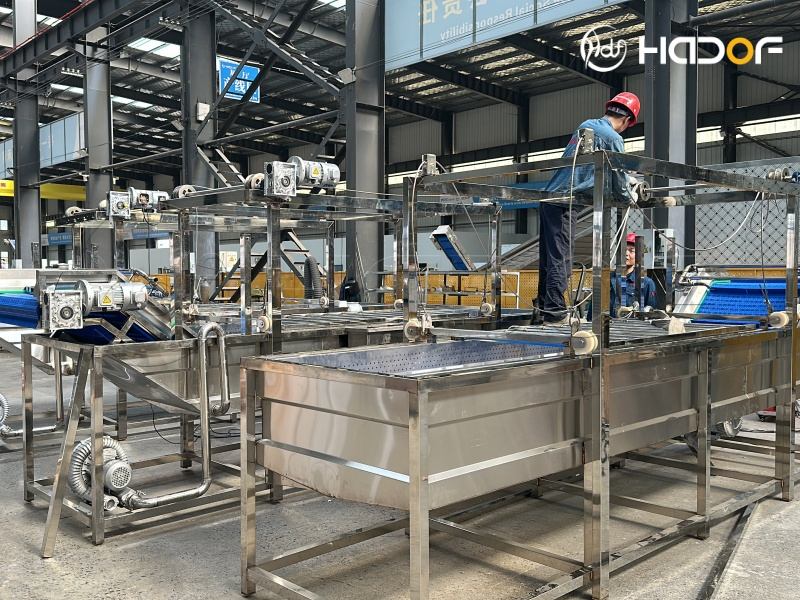
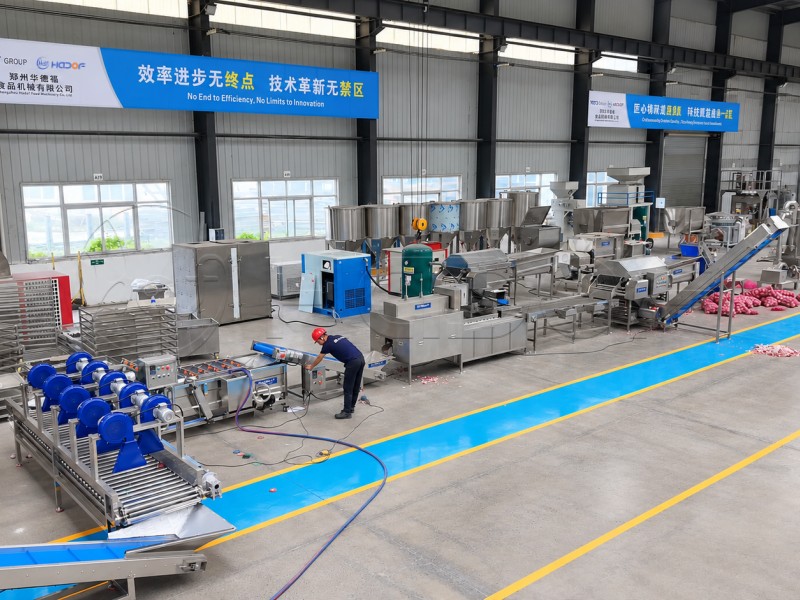
On February 20, 2026, Hadof received an inquiry from Uzbekistan for an industrial onion processing project. The customer, Mr. Akmal Rakhimov, came from Samarkand Region, 우즈베키스탄. He managed an agricultural processing business purchasing fresh onions, potatoes, carrots, etc. 그 다음에, his company grades, cleans, and packs these products for supermarket chains and regional food distributors. 그 동안에, his company exported agricultural products to Russia, Kazakhstan, and other Central Asian markets. 하지만, manual onion peeling limited production stability during high-season purchasing. Now, he intended to transition an agricultural processing enterprise from selling bulk fresh onions. 그러므로, Mr. Rakhimov wanted a 1,500 kg/h onion processing line in Uzbekistan for standardized industrial onion processing. 추가적으로, his new onion processing project required peeling, trimming, washing, surface drying, conveying, and vacuum packing. For this reason, our engineering team started the project evaluation from his raw material and sales model.
How Did Hadof Design The 1,500 KG/H Onion Processing Plan in Uzbekistan?
 Uzbekistan continues to promote fruit and vegetable processing and export-oriented agricultural reforms
.
The country also provides tax incentives for eligible food processing investments and export-oriented enterprises.
The company purchases 2,000–3,000 tons of fresh onions annually from contracted farmers,
cooperatives,
and wholesale suppliers in Samarkand and surrounding areas.
He currently has an available workshop of approximately 600 m²,
existing cold-storage facilities,
and an equipment budget of about USD 80,000. 그 동안에,
he plans to process fresh onions for supermarket chains,
catering companies,
food factories,
and foreign importers.
Russia,
Kazakhstan,
and Turkey represented important export destinations for his future onion business.
Thus,
the customer needed more than an onion peeling machine for individual operation.
He required a complete onion preparation system with stable material flow and consistent treatment. 게다가,
he already has sufficient raw materials,
workshop space,
and investment funds.
Accordingly,
we designed a 1,500
kg/h onion processing line with the following process:
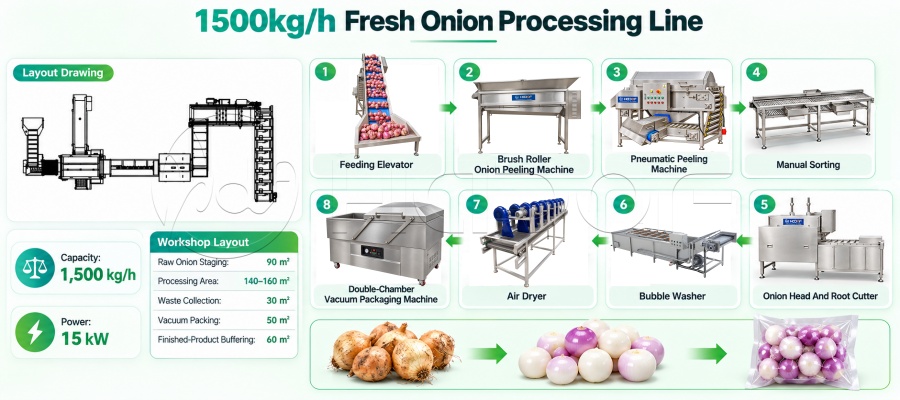
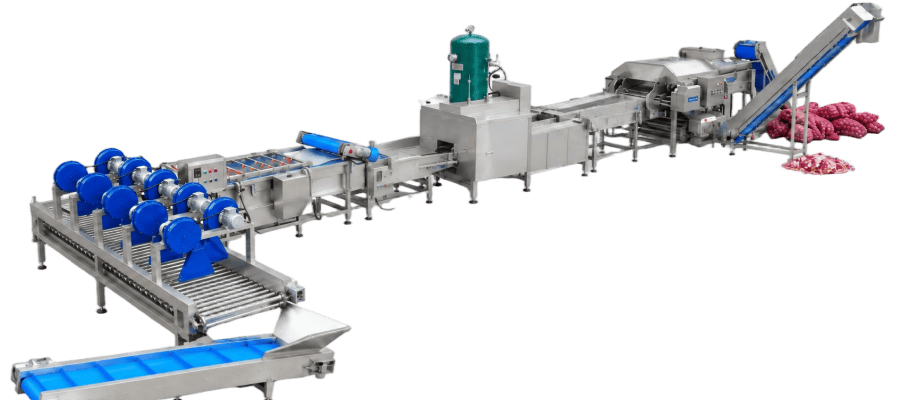
Automatic Feeding → Two-Stage Peeling → Top and Root Cutting → Washing → Air Drying → Conveying → Vacuum Packing.
We design workshop layout includes 90
m² for raw onion staging, 140
–160 m² for the processing area, 30
m² for waste collection, 50
m² for vacuum packing,
and 60
m² for finished-product buffering.
This system requires approximately 6–8 operators,
which can significantly reduce dependence on manual peeling and handling.
This project targets an estimated investment payback period of approximately 8–13 months.
During the first stage,
Akmal planned to sell whole peeled onions.
Later,
he could expand into higher-value products such as sliced onion,
diced onion,
dried onion,
and onion powder.
Which Onion Processing Equipment Did Hadof Recommend for Industrial Fresh Onion Project?
Our engineering team selected equipment according to each processing step and customer requirement. The final onion processing system separated product flow, waste flow, inspection, washing, drying, 그리고 포장. 게다가, the complete onion machinery arrangement connected product handling with independent onion-skin waste management.
-
Automatic Feeding & Two-Stage Onion Peeling
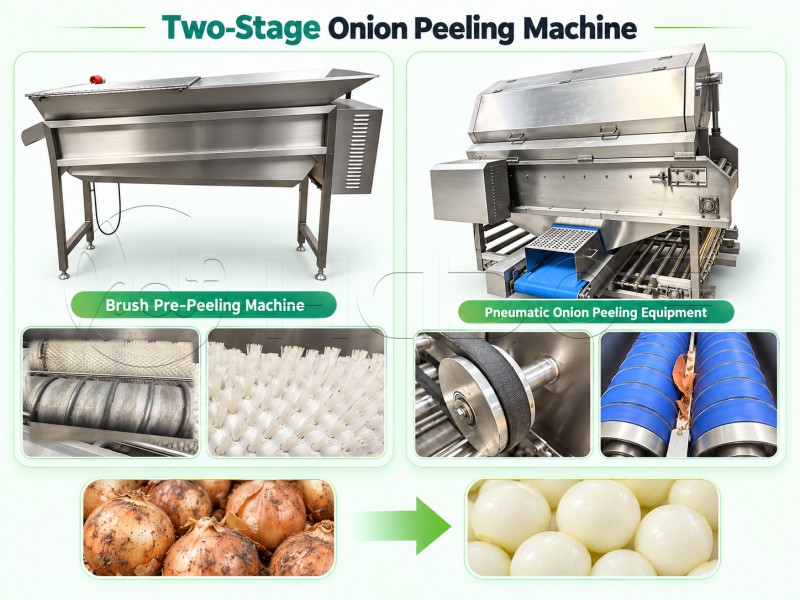
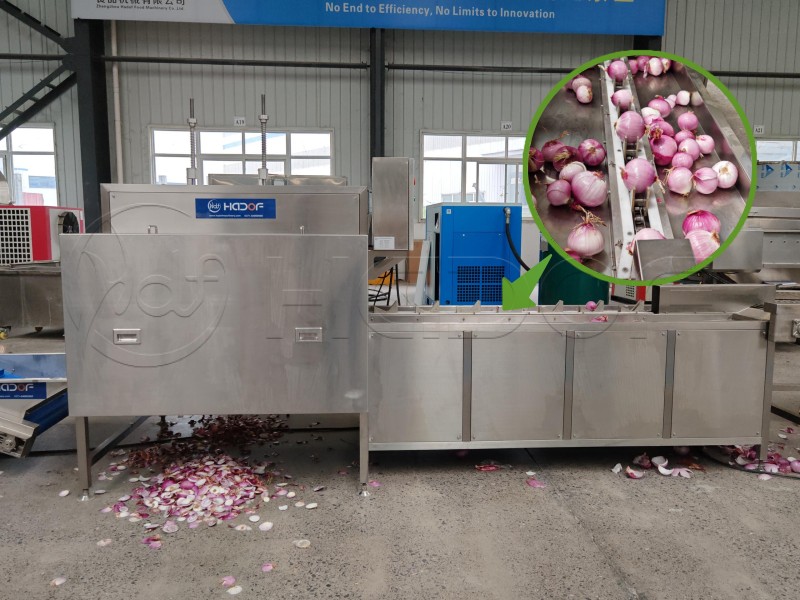
The feeding elevator transfers whole onions from the raw material area into the peeling section. 그 다음에, we recommend the Level 2 onion peeling method to Mr. Rakhimov. First, the brush pre-peeling machine uses flexible brushes to loosen dry skins and remove surface soil. Afterward, the pneumatic onion peeling equipment removes loosened lightweight skins with high-pressure airflow. This two-stage onion peeling technique reduces excessive mechanical contact with the onion flesh. 뿐만 아니라, the pneumatic peeling system requires a 55 kW air compressor at 0.6 MPa. This customer could purchase the compressor locally or source it through our company. 그 동안에, our design included two independent conveyors for product flow and waste flow. The waste conveyors transferred loose onion skins away from the main processing route.
자세히 알아보기
-
점검 & Automatic Onion Trimming
Mr. Rakhimov still retains 3 manual inspection positions after the onion peeling process. This does not mean that the low level of automation. Because natural onions show differences in size, shape, skin condition, and mechanical damage. So manual inspection could remove residual skins, damaged bulbs, and irregular onions before automatic trimming. 그 다음에, 그만큼 1.5 t/h onion top and root cutter handles onions with approximately 6-15 cm diameters and lengths up to 22 cm. Also, its feeding, holding, and cutting mechanisms complete continuous head and root removal.
자세히 알아보기
-
Onion Washing And Surface Drying
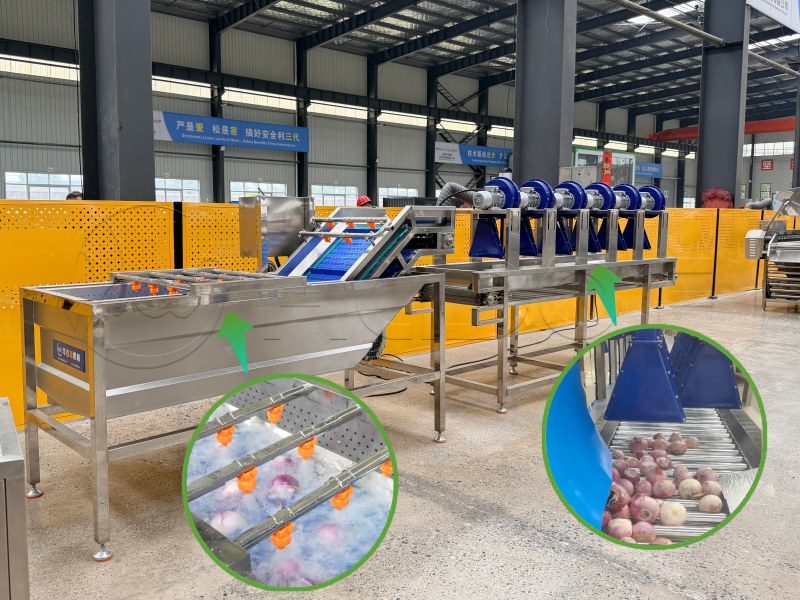
We recommend a 3M bubble washing machine after the trimming section. The onion washer combines bubble movement, water circulation, and spray cleaning during continuous onion handling. 그러므로, peeled onions rotate gently while water removes remaining skins and surface impurities. Next, the onions enter a 4M parallel air dryer. It reduces free water from cleaned onion surfaces. The roller structure continuously changes onion contact positions during air drying. Importantly, the air dryer reduced surface moisture. Hence, the dried onion surface became more suitable for vacuum packing and further processing.
자세히 알아보기
-
Conveying And Vacuum Onion Packing
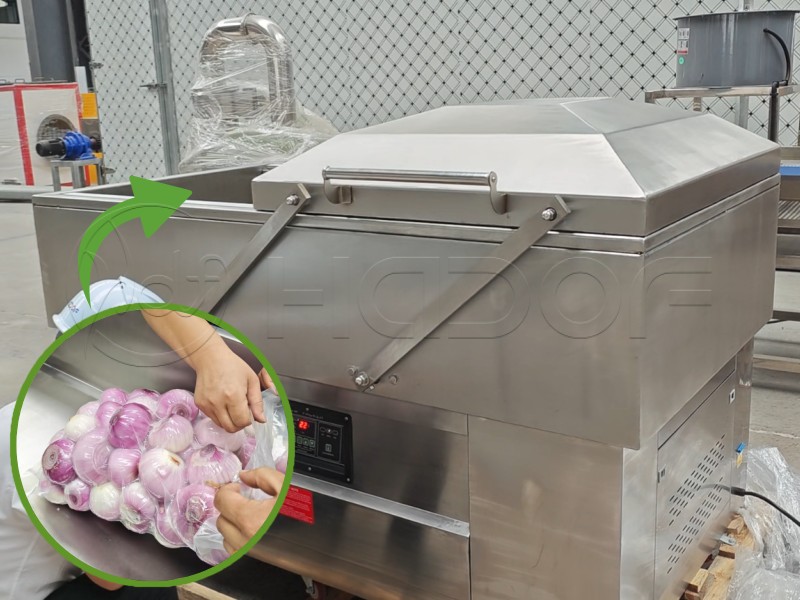
The conveying system connects the drying section with the final packing area. Our design includes anti-collision foam at transfer points. 그러므로, the system could reduce onion damage during material transfer. Next, a horizontal conveyor maintains stable feeding toward the vacuum packaging station. 그 다음에, double chamber vacuum packing machine completes the fresh onion packing procedure. The device removes air before heat sealing and supported cold-chain transportation. Consequently, the customer could prepare peeled onions for supermarket distribution and export markets.
자세히 알아보기
What Was The 1,500 KG/H Onion Processing Line Price?
After several rounds of technical discussions, Hadof and Mr. Akmal reviewed several onion processing quotations before they confirmed the revised solution. The final equipment quotation reached $77,515 USD for the complete 1,500 kg/h fresh onion processing solution. He signed the contract on April 16, 2026, and paid a 30% deposit of $23,254.50. Our company completed onion equipment manufacturing within about 20 working days. 그 다음에, we arranged FAT on May 25, and he paid the next 40% of $31,006. 마지막으로, he paid the remaining 30% balance of $23,254.50 on June 5 before delivery.
Paremeters of 1,500KG/H Onion Peeling, 세탁, Packing Solution
| Name |
용량 |
Power |
Dimension |
Quantity |
가격 |
| Elevators |
/ |
0.55kw*3 |
/ |
3 Set |
$6,932 |
| Conveyor |
/ |
0.37 kw |
2500×500×850 mm |
1 Set |
$1,890 |
| 브러시 필링 기계 |
/ |
0.55 kw |
2000×645×1220 mm |
1 Set |
$6,154 |
| Skin Blowing Machine |
/ |
1.29 kw |
2190×1510×1635 mm |
1 Set |
$28,295 |
| 3-station Sorting Conveyor |
/ |
0.55 kw |
3090×1650×1020 mm |
1 Set |
$3,569 |
| Onion Top & Root Cutter |
1.5 t/h |
1.05 kw |
3045×1180×1940 mm |
1 Set |
$12,640 |
| 3M Bubble Washing Machine |
1.5–2 t/h |
2.25 kw |
3000×1200×1300 mm |
1 Set |
$6,000 |
| 4M Roller Air Dryer |
/ |
1.5 kw |
4000×1150×1450 mm |
1 Set |
$7,435 |
| Double Chamber Vacuum Packing Machine |
/ |
5.5 kw |
Internal: 750×250 mm |
1 Set |
$4,600 |
| Total Power |
15 kw (Excluded 55 kW Air Compressor) |
| Total Price |
$77,515 USD |
If you have any questions, please contact us for free quote!
How Did Hadof Arrange Transportation and Installation of 1,500 kg/h Onion Processing Plan in Uzbekistan?
-
China–Uzbekistan Rail and Road Transportation
After the final payment, we prepares two 40HQ containers with wooden cases, pallets, moisture protection, foam cushioning, and lifting labels. On June 8, 2026, our logistics team moved the packed onion machinery from Zhengzhou toward Xi’an International Port. The domestic transfer required 3-4 days. Next, the containers followed the China–Central Asia rail corridor through Horgos, Kazakhstan. 뿐만 아니라, the containers reached the Tashkent terminal on June 23. Afterward, local trucks moved both containers about 280 kilometers toward Samarkand Region. The equipment reached the customer’s Jomboy District installation site on June 25. The entire shipping process typically takes about 18–20 days, and the transportation expenses cost $9,000.
-
Delivery, 설치, and Customer Service
Before shipment, our engineers prepared the FAT and reviewed machine start-up, control functions, conveying direction, and safety systems. The testing covered fresh onion feeding, 필링, onion-skin disposal, trimming, washing, surface drying, packing, and emergency-stop functions. 게다가, our factory completed FAT within three days and issued a written FAT report. 게다가, the planned installation period started around July 5–10, 2026. First, Mr. Akmal’s local team handled workshop utilities and civil modifications. Also, we provided installation drawings, electrical diagrams, pneumatic diagrams, and online commissioning guidance. 뿐만 아니라, our team offered free remote training for startup, PLC operation, cleaning, maintenance, and safety procedures.
What Customer Feedback Did the Uzbekistan Onion Processing Project Generate?
"
We used to run 50
peelers in the high season,
and the output was never stable.
The Hadof 1,500
kg/h line changed that.
Two-stage peeling keeps the bulbs whole,
the air dryer gives us dry onions for vacuum packing,
and our staff now works on sorting and packing instead of peeling.
The line reached full capacity in one week."

Mr. Akmal Rakhimov, General Manager, 사마르칸트, 우즈베키스탄
CUSTOMER
The Uzbekistan project shows how an industrial customer can upgrade from bulk onion trading toward standardized food processing. 에이 1,500 kg/h onion peeling and washing line can support peeled whole onions first. 하지만, the same onion preparation system can also support future downstream products. Hadof can also develop onion washing, onion peeling, onion cutting, onion drying, onion milling, and onion packing solutions. 그러므로, customers with raw onions, factory space, investment budgets, or expansion plans can discuss their projects with our engineering team. And we can develop the onion processing proposal, onion plant layout, equipment configuration, 자동화 수준, and quotation around each factory.



 30-40 Days Shipping