[email protected] Citere



[email protected] Citere
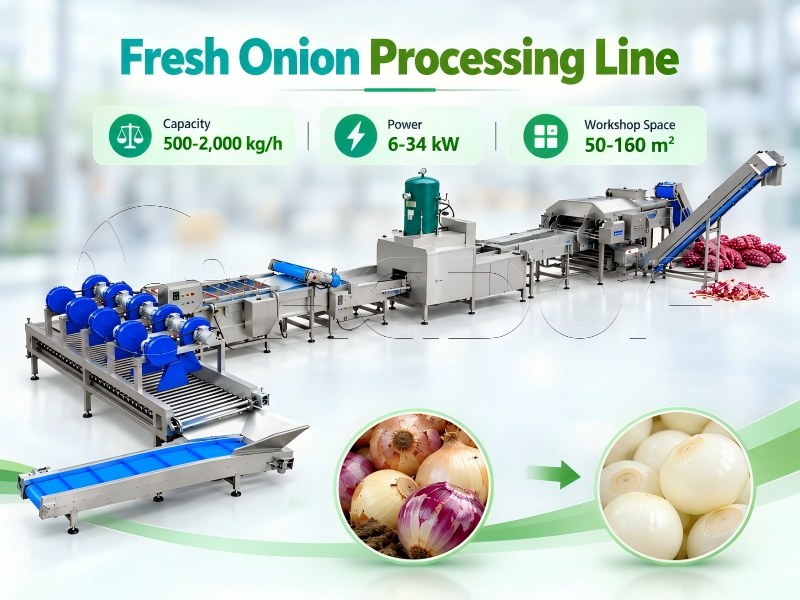
Onion pre-processing is the first critical stage for fresh-cut vegetables, prepared foods, fried onion products, and onion powder production. For large food processors handling of fresh onions, increasing labor alone cannot solve peeling efficiency, product consistency, labor costs, and hygiene challenges. Derfor, customers can choose a suitable fresh onion processing line based on capacity, onion size, final products, labor conditions, workshop space, and budget. Imidlertid, customers with limited investment budgets can choose a semi-automatic onion processing solution. For tiden, for 1,500-2,000 kg/h onion production projects, you can integrate continuous feeding, two-stage peeling, automatic top and root cutting, high-pressure washing, air drying, vacuum packing, and cold storage for higher automation.
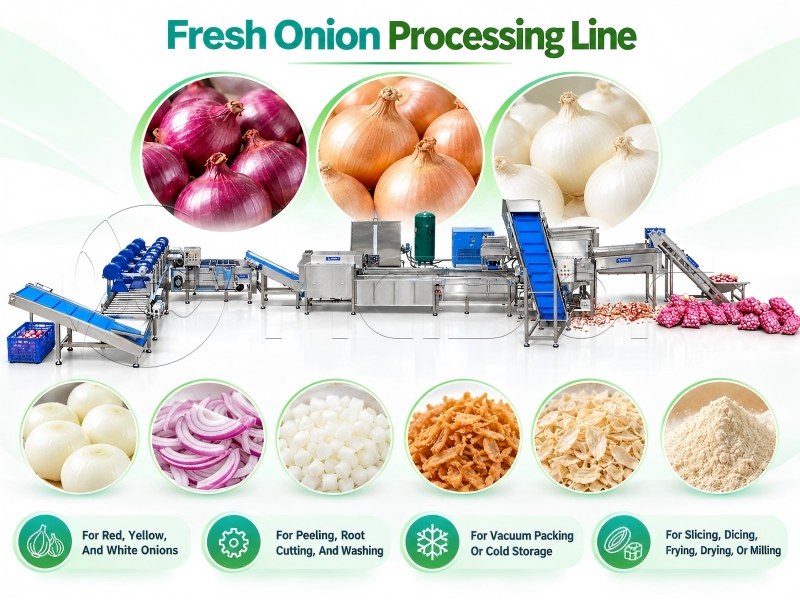
An onion peeling and washing line serves many kinds of food factories. Faktisk, you should choose the onion production line configuration according to the final product you plan to produce. In this way, one onion processing design can support different commercial onion production plans.
 Få tilbud
☑This onion preparation system is suitable for fresh whole onions with dry outer skins like red, yellow, and white onions needing customizable peeling and washing procedures.
☑Desuden, the production line suits onions that need skin removal, root cutting and washing before further processing.
☑Or you can use this design to peel whole onions intended for vacuum packaging or cold storage sale.
☑Desuden, you can feedpre-processed onions for subsequent operations such as slicing, dicing, frying, tørring, or milling into powder.
Our current top and root cutting equipment commonly handles onions with 6–15 cm diameters. The maximum onion length can reach about 22 cm for this configuration. Imidlertid, our company can customize the cutting system for different onion sizes. Customers can use this onion preparation process before fresh-cut, frozen-food, fried-onion, or dehydration production.
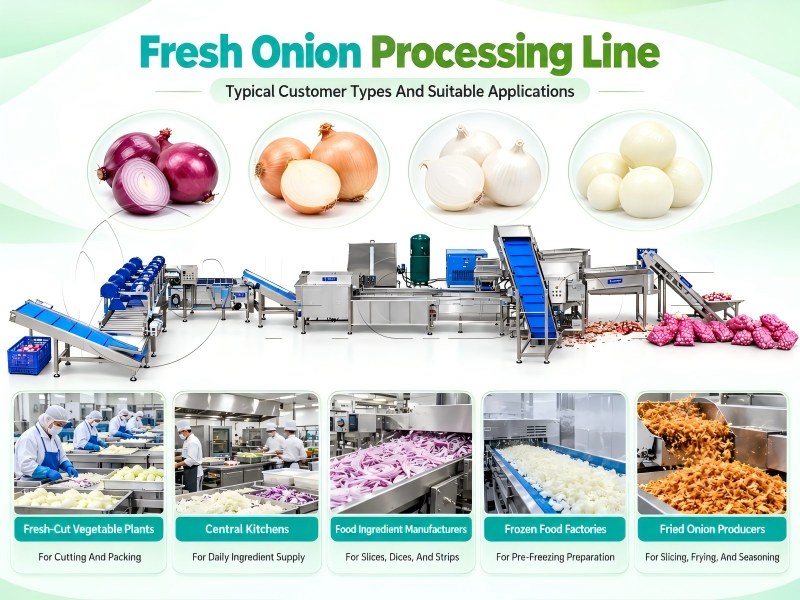
Fresh-cut vegetable plants can use onion peeling and washing equipment before cutting and packing. Central kitchens can process peeled onions for daily meal preparation and ingredient supply.
I mellemtiden, food ingredient manufacturers can cut onion slices, dices, or strips before peeling and cleaning system to serve as ingredients.
Frozen food factories can use the onion preparation section before freezing or further cutting.
Fried onion producers can connect peeling and washing with slicing, battering, frying, and seasoning.
Derudover, onion packing plants can connect washing, sortering, vacuum packing, and cold-chain handling.
Følgelig, agricultural processing projects slice or shred clean onions for drying and grinding into onion powder.
 Få tilbud
If the client only need to process a small amount of onions daily, a simpler semi-automatic peeling and washing system configuration is a suitable choice. Conversely, customers requiring continuous and multi-shift production can select a higher-automation onion processing solution with automatic feeding, two-stage peeling, automatic top and root cutting, vask, and automatic conveying systems.
Different clients have different onion production capacity, workshop areas and investment budgets. As a result, we configure each onion processing system in modular stages. Desuden, the final quotation changes with the onion size, the peeling requirement and the automation level. These three plans show the price, the floor area and the power for a fresh onion processing line. Så, you can pick the plan that fits your project.
A 500 kg/h onion peeling and washing line is suitable for customers who are entering the onion processing industry, as well as small fresh-cut vegetable plants and central kitchens. With the limited budget, you don’t need to purchase all equipment at once. Instead, you can invest step by step and prioritize peeling and washing, which are the most important equipment of onion pre-processing. It includes an onion brush pre-peeling machine, manuel sorteringstabel, bubble washing machine, and vibrating drainer or air dryer. I mellemtiden, you can replace the automatic elevator with manual feeding, use manual removal instead of an automatic root cutter, and connect existing cold storage facilities instead of purchasing new ones. Derfor, Derfor, purchasing a semi-automatic 500 kg/t onion washing line may spend $18,000–28,000 med 50–80 m² workshop space and 6–8 kW total power.
Læs mere
A standard automatic onion peeling and washing line is suitable for commercial fresh-cut vegetable plants, food processing companies, and projects requiring stable output at around 1,000 kg/t. We recommend configuring an onion brush peeling machine, pneumatic onion peeling machine, sorting platform, automatic top and root cutter, bubble washing machine, and parallel air dryer. Udover, you can add automatic feeding, continuous conveying, multi-stage washing, automatic waste discharge, and automatic draining systems according to your requirements. Således, most material transfer and core processing steps can operate automatically, while a manual sorting station remains useful for appearance inspection and final trimming. To be honest, the budget for a 1,000 kg/h onion processing line is USD 35,000–45,000, med 90–110 m² workshop space and 16–22 kW total power.
Læs mere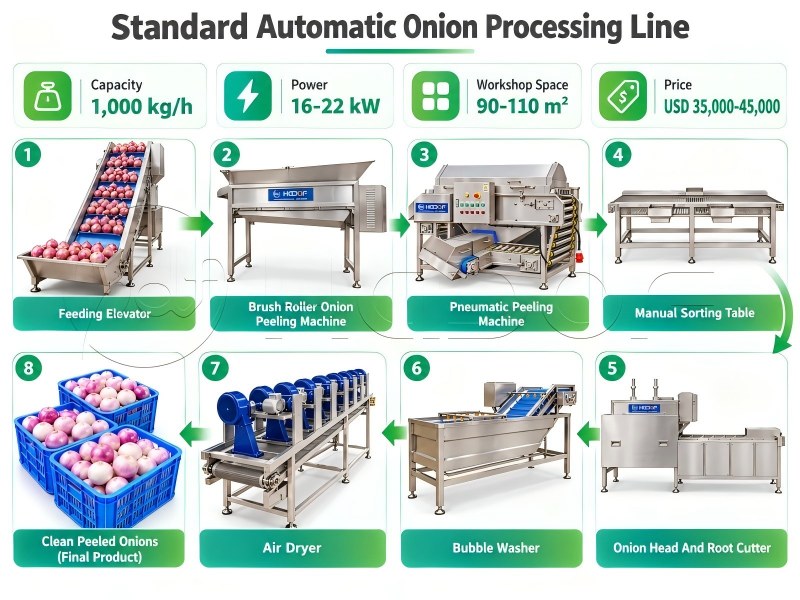
Large industrial food factories, high-volume fresh-cut vegetable projects, and customers requiring direct packaging and cold storage can choose a complete onion processing solution. A 1,500–2,000 kg/t fresh onion processing line usually requires an investment of approximately USD 60,000–80,000, med 110–160 m² workshop space and 27–34 kW processing power. The complete onion processing flow includes automatic feeding, brush pre-peeling, pneumatic peeling, automatic waste removal, inspektion, automatic top and root cutting, bubble washing, air drying, vacuum packing, detection interface, and cold storage. Derfor, this solution fits large-scale continuous onion production. Operators mainly handle raw material supply, quality inspection, abnormal product removal, and packing operations, while machines maintain continuous material transfer between processing stages.
Læs mere
An onion processing procedure turns whole raw onions into clean, peeled material for packing or further production. Desuden, the following onion processing procedure separates peeling, waste disposal, trimming, vask, surface drying, and optional packing. Derfor, each processing step should prepare onions for the next machine. Customers can adjust individual sections according to onion condition and final product requirements. The following procedure shows how fresh onions move through an industrial preparation system.
Our plant offers more than a list of machines. Faktisk, we design the onion processing system around your product, your capacity and your budget. Følgelig, you get a line that matches your production conditions.
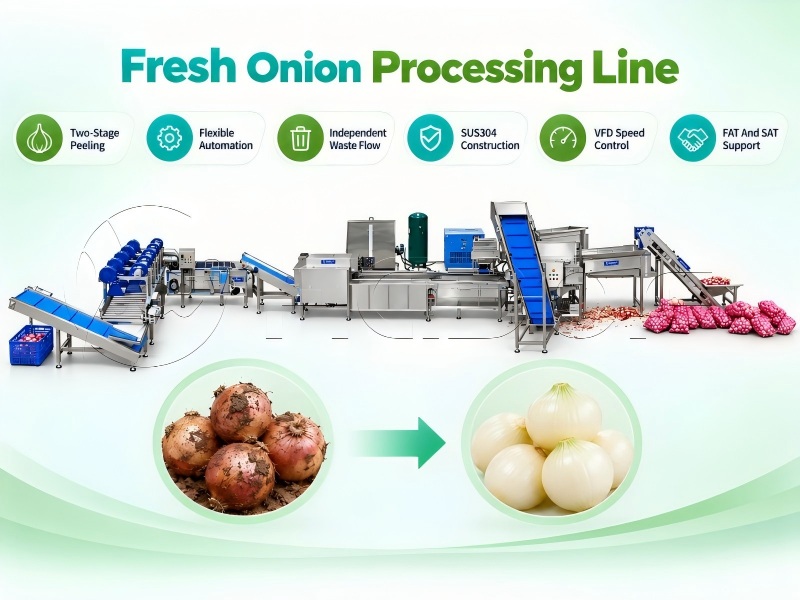
We combine mechanical skin loosening with pneumatic blowing in view of the thin skin characteristic of onions. Faktisk, this two-stage peeling avoids putting the whole task on one machine. Brush rollers loosen skins first, and compressed air removes them next.
You do not need to buy every machine at the beginning. I mellemtiden, you can choose a manual, semi-automatic, automatic or high-automation onion processing equipment configuration. Desuden, this flexibility helps you control onion line investment and labor cost.
The waste conveyor separates onion skins from the main product route. Udover, fodring, skrælning, sortering, skæring, washing and dewatering connect in another one continuous flow. Følgelig, the production workshop can maintain clearer management and waste handling.
Our core processing equipment commonly uses SUS304 stainless steel for main structures and food-contact parts. Imidlertid, blades, belts, panels, and other components can use different materials according to their functions. F.eks, we use 420J2 blades, PP/PVC/PU belts and PU cold-room panels.
Many conveying and processing stations use variable-frequency drives. Derfor, you can adjust the processing speed to match different onion conditions.
Our reference project includes factory acceptance testing, PLC operation checks, written FAT records, and site acceptance testing. Desuden, these steps help buyers verify project scope before routine production.
A complete industrial onion peeling and washing line does not rely on a single peeling machine. Instead, multiple machines work together to transform whole unpeeled onions into clean materials ready for packing or further processing. Each machine performs a specific task: feeding equipment ensures stable material supply; peeling equipment reduces manual work; conveyors maintain continuous material flow; sorting equipment improves raw material quality; washing equipment removes impurities; and drying and packing equipment increase product value.
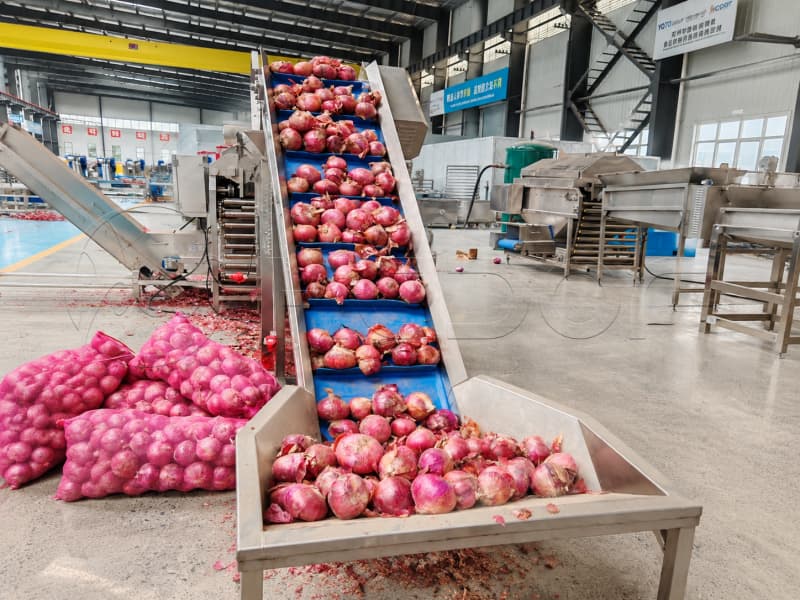
The elevator is the first machine in an onion processing line. It continuously lifts and transfers bulk onions from the feeding area to the next processing stage through a belt or chain conveyor system. Derfor, it reduces repeated manual handling and creates a stable material supply. The variable frequency drive (VFD) adjusts the feeding speed to match downstream equipment, preventing overload or idle operation. The power usually ranges from 0.75–2.2 kW depending on capacity, while the lifting height and length can be customized according to your workshop layout.
Få tilbud
The brush peeling machine uses flexible brush rollers to rub, rotate, and loosen onion skins before pneumatic peeling. Its main purpose is not to remove all skins directly, but to prepare onions for the next peeling stage. The brush system uses multiple parallel nylon or PP brushes to loosen the outer dry onion skins. The rotating brushes can also remove surface soil and lift loose skin edges. It just loosens the skin without damaging the onion flesh. Derfor, the machine prepares onions for pneumatic skin removal without excessive flesh abrasion.
Få tilbud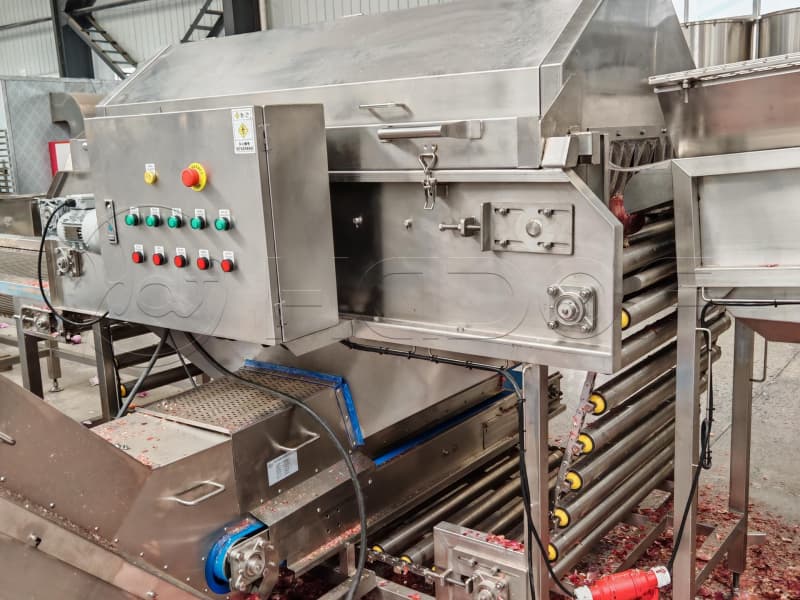
The pneumatic system uses compressed air to remove loosened onion skins. The chain conveyor moves onions forward while high-pressure airflow sprays from multiple directions to separate the outer skin. Unlike mechanical peeling methods, the air blowing peeling process reduces physical damage because airflow removes the thin skin without cutting into the onion flesh. This dry peeling method avoids water soaking, maintains onion appearance, and supports continuous industrial processing with better product quality.
Få tilbud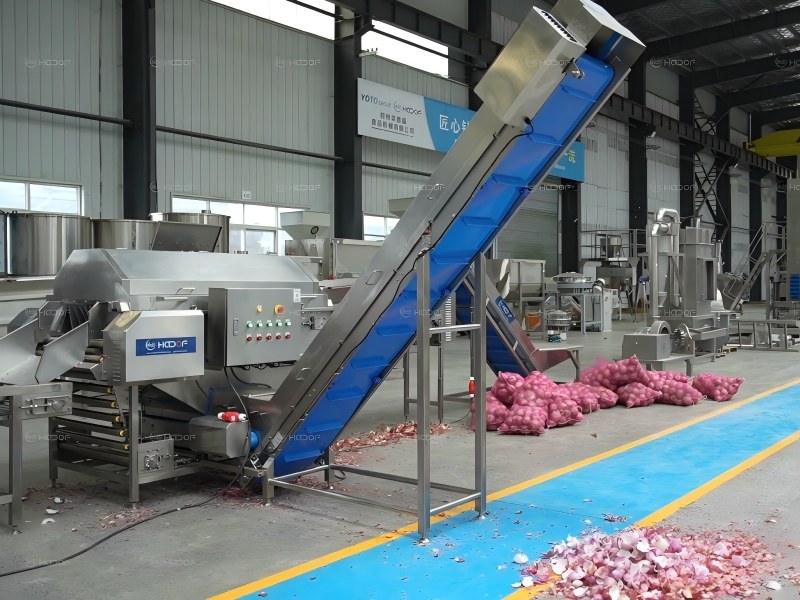
The waste conveyor independently handles onion skin disposal and quickly removes peeled waste from the main onion production line. The peeling section collects separated skins through a hopper or collection area, and the conveyor transfers them to a waste zone or collection bags. Derfor, the system prevents skin accumulation, avoids contamination of finished products, and keeps the workshop cleaner. The conveyor operates separately from the main processing flow to prevent waste from returning to washing or packing sections. The power usually ranges from 0.37–0.75 kW, with customized length according to capacity.
Få tilbud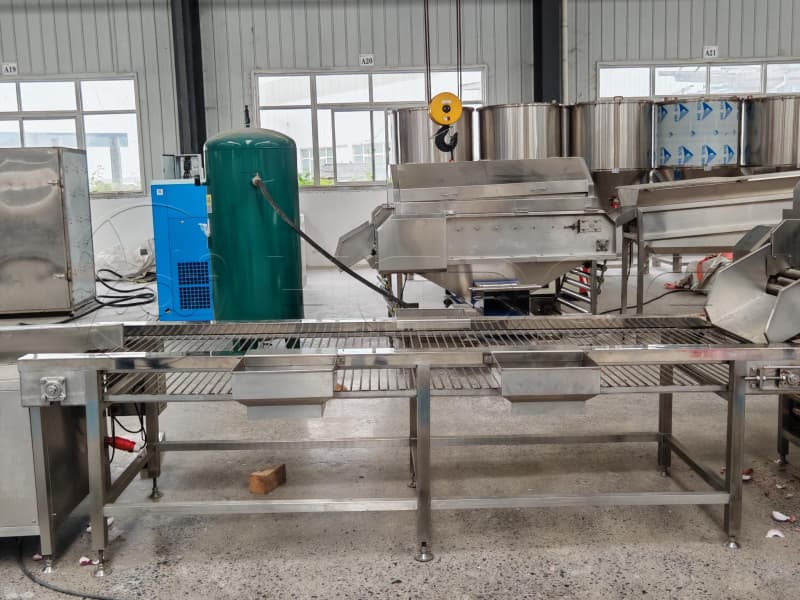
The sorting conveyor provides an inspection stage after peeling. Operators check onions moving on the conveyor and remove residual skins, damaged onions, soft onions, or foreign materials. Since natural onions vary in size, shape, skin condition, and quality, manual sorting helps maintain consistent feeding conditions for the following processes. As a result, the sorting platform improves the stability of top and root cutting, vask, and packing operations while reducing final product defects. The conveyor width usually ranges from 500–1000 mm, with power of 0.37–1.5 kW depending on configuration.
Få tilbud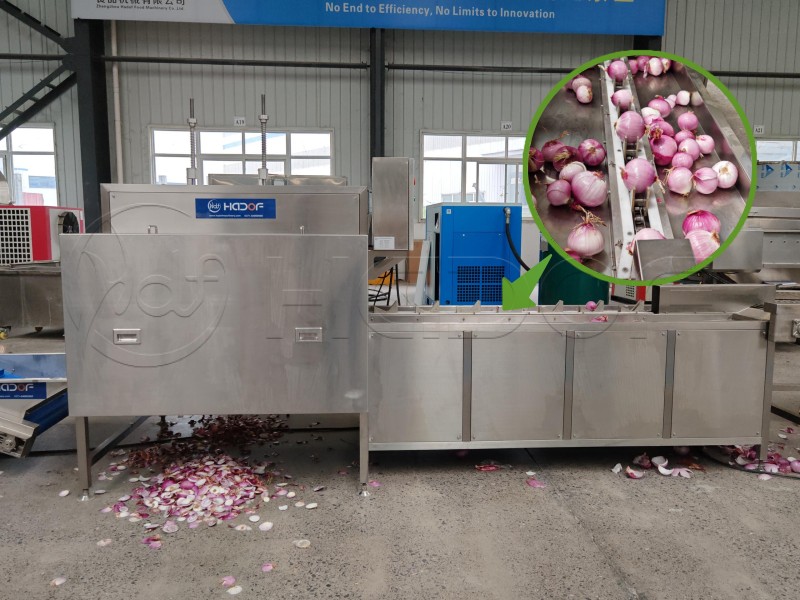
The onion top and root cutter automatically removes the top and root sections of onions before washing or further processing. The feeding mechanism positions onions, while the holding system fixes them before the cutting blades remove both ends simultaneously. The adjustable blade distance allows the machine to handle different onion sizes. Compared with manual trimming, the automatic cutting system provides higher efficiency, consistent cutting results, and stable production capacity. Derfor, it eliminates the bottleneck caused by manual cutting in large-scale onion processing projects.
Få tilbud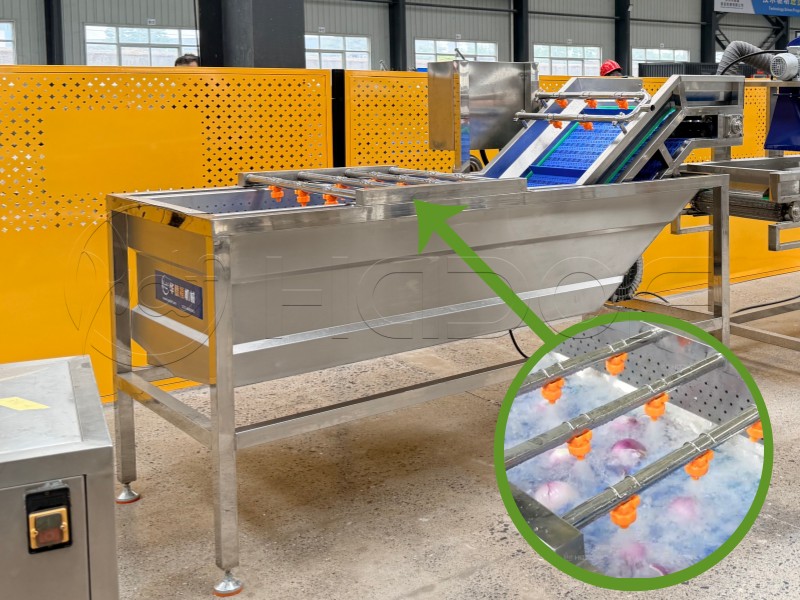
The bubble cleaning machine combines water movement, bubble agitation, and high-pressure spray cleaning to remove impurities after peeling and cutting. Air bubbles generated at the bottom of the tank create gentle water movement, which makes onions rotate and improves cleaning efficiency. Floating impurities flow away through overflow channels, while heavier dirt settles in the bottom tank. The high-pressure spray system provides additional surface cleaning, and optional ozone sterilization functions can be added. This washing technology provides gentle cleaning without damaging onions. The capacity ranges from 500–2000 kg/t, with power from 2.25–5.2 kW.
Få tilbud
The air drying equipment removes free surface water remaining after onion washing. Multiple rollers, transportører, and airflow systems work together to blow away moisture from surfaces of onions. Derfor, the equipment reduces excessive water entering the packing process and helps prevent condensation during storage and transportation. The air dryer creates a cleaner and drier surface condition for vacuum packing, further cutting, or cold storage. It improves packing stability and supports better product quality during distribution.
Få tilbud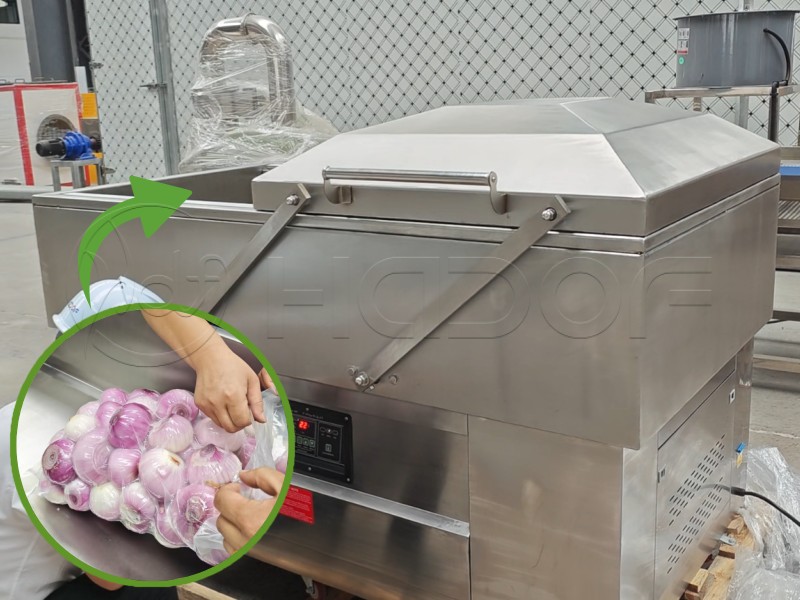
The vacuum packing machine packs peeled and dried onions, including whole onions, onion rings, or diced onions, into sealed bags. The machine removes air inside the package and completes heat sealing, creating a low-oxygen environment that helps reduce oxidation and microbial growth. So, vacuum packing improves product appearance, extends storage stability, and supports cold-chain transportation and export supply. As the final stage of the onion processing line, the packaging system connects fresh onion preparation with commercial product delivery. Customers can choose single-chamber, double-chamber, or continuous vacuum packaging solutions according to production requirements.
Få tilbudFodring, pre-peeling, pneumatic peeling, waste removal, skæring, vask, drying and vacuum packing can all run with high automation. Imidlertid, an economy onion processing plan can use more workers for feeding, sortering, cutting and packing. Følgelig, if you want to remove manual inspection, we can confirm an automatic sorting solution.
The two peeling machines perform different tasks. The first brush pre-peeling machine mainly loosens the skins. The second pneumatic peeling machine mainly removes them. Derfor, loosening first and blowing later matches the light onion skins.
◆If you produce fresh-cut onions, the cutting machine and packaging system can connect after washing and air drying. The onion slicing machine uses different blades for final product sizes.
◆If you produce diced onions, the onion dicing machine can connect after air drying. Our root vegetable dicing equipment also processes onions and other bulb vegetables.
◆If you produce shredded onions, our high-speed onion shredding machine provides customized cutting sizes according to requirements.
◆If you plan to produce fried onion rings, onion ring cutting, coating, and frying equipment can connect after peeling, vask, and air drying.
◆If you produce onion powder, onions can continue through slicing, shredding, tørring, and grinding processes after washing and air drying.
Customers should provide the following information:
◆Target Capacity: You should specify the required processing capacity, such as 500 kg/t, 1,000 kg/t, 1,500 kg/t, or 2,000 kg/t.
◆Final Product: You need confirm the final onion products, such as peeled onion, sliced onion, diced onion, onion powder, dried onion, or frozen onion.
◆Automation Requirement: You can define the required automation level, such as semi-automatic, automatic, high automation, or complete onion production line.
◆Workshop Size: Customers should provide workshop details, including length, bredde, height, existing equipment, water supply conditions, and electrical conditions.
◆Investment Budget: Customers should provide their expected investment range. F.eks, -en USD 20,000–30,000 budget can focus on a basic semi-automatic onion processing system configuration; -en USD 40,000–60,000 budget can support continuous onion conveying and multi-stage washing; while a USD 60,000–100,000+ budget can consider higher automation levels and downstream processing equipment.
Efterlad din besked
 Gratis tilbud
 Dansk
 English
 Afrikaans
 Shqip
 العربية
 Հայերեն
 Azərbaycan dili
 Беларуская
 Bosanski jezik
 Български
 မြန်မာစာ
 Hrvatski
 Čeština Dansk
 Nederlands
 Eesti keel
 Wikang Filipino
 Suomi
 Français
 Galego
 Deutsch
 Ελληνικά
 हिन्दी; हिंदी
 Magyar
 Íslenska
 Bahasa Indonesia
 Gaeilge
 Italiano
 日本語
 Қазақ тілі
 한국어
 ພາສາລາວ
 Latīna
 Latviešu valoda
 Bahasa Melayu
 Монгол
 नेपाली
 Norsk
 Português
 Português do Brasil
 Română
 Русский
 Cрпски језик
 Slovenčina
 Slovenščina
 Español
 Svenska
 ภาษาไทย
 Türkçe
 Українська
 Oʻzbek tili
 Tiếng Việt
Du kan ikke kopiere indholdet af denne side